Base Mainnet Suffers Second Outage in Two Days, Service Restored
Base mainnet halted for the second time in two days on June 26, 2026, before block production resumed roughly 14 minutes later, raising pointed questions about the Coinbase-incubated Layer 2 network’s operational reliability.
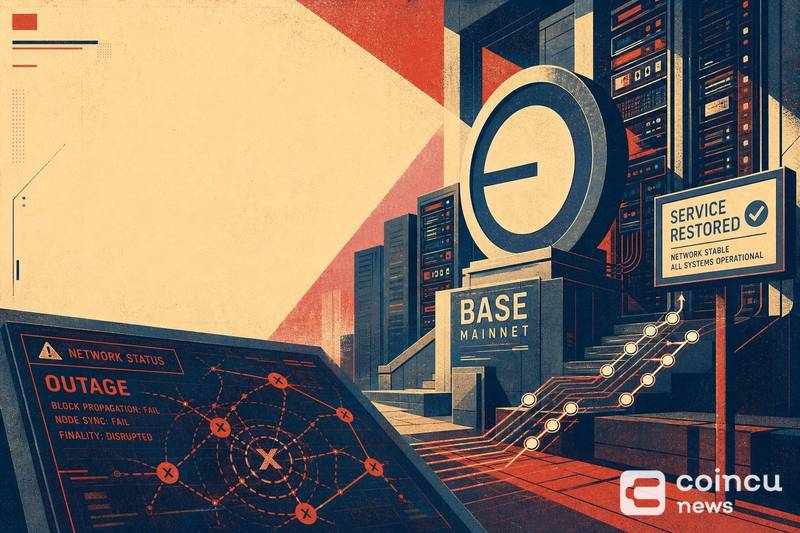
The chain’s official status page marked block production as unhealthy at 15:33 UTC on June 26. By 15:34 UTC the team described the incident as a chain halt with symptoms similar to the previous day’s disruption. Block production resumed at 15:47 UTC, and the incident was marked fully resolved at 20:03 UTC. For related coverage, see Russia Plans 2026 Crypto Mining Ban in Moscow and Key Areas.
June 25 outage set the stage for a repeat disruption
The first outage began at 16:03 UTC on June 25 when a consensus problem produced an invalid block after block 47806542. The Base team confirmed sequencing resumed at 17:51 UTC that day, roughly one hour and 48 minutes after the initial halt.
L2BEAT data flagged a corresponding liveness anomaly on June 25, showing no transaction data submissions for 1 hour, 18 minutes and 12 seconds between 16:05 UTC and 17:23 UTC. That gap aligns closely with the window Base’s own status page reported.
The back-to-back nature of the halts, with the second occurring less than 24 hours after the first, distinguishes this episode from an isolated incident. Base’s status update noted the June 26 halt showed “similar symptoms” to the previous day’s problem, though a full root cause analysis had not been published at the time of writing.
Beryl upgrade delayed after stability concerns
The outages coincided with Base’s planned Beryl mainnet upgrade, originally scheduled for 18:00 UTC on June 25. That upgrade required node operators to run software version 1.1.1 or greater.
Base’s documentation now states that B20 mainnet activation was delayed because of an unrelated stability incident. The timing overlap between the scheduled upgrade window and the first outage adds context to why reliability concerns sharpened quickly among builders and users.
The delay mirrors a broader pattern across Layer 2 networks where upgrade rollouts intersect with operational disruptions, a dynamic that has also surfaced in discussions around declining liquidity staking TVL across the ecosystem.
Scale of the affected network
Base is not a minor testnet. DeFiLlama data lists the chain with a total value locked of approximately $6.41 billion, ranking it fourth among all chains in that dataset.
L2BEAT classifies Base as a Stage 1 optimistic rollup using ETH as its gas token, with $10.94 billion in total value secured. For a network of that scale, even a 14-minute halt can disrupt active trading, bridging operations, and DeFi positions.
Despite the consecutive outages, Base’s status dashboard currently reports 99.5% mainnet uptime over the last 90 days, with 98.71% block-production uptime over the same period.
Base founder responds, promises postmortem
Jesse Pollak, Base’s founder, addressed the halt publicly and acknowledged that the disruption was unacceptable for a network positioning itself as infrastructure for “global, 24/7 finance.”
re: the chain halt today, the team has identified and patched the root cause and a full post-mortem is coming.
all funds are/were safe. but a halt is not okay and we’ll use this to continue to level up base as a platform for global, 24/7 finance. thank you for your patience.
— jesse.base.eth (@jessepollak) June 26, 2026
Source: @jessepollak on X
Pollak’s claim that all funds were safe during the halt has not been independently verified through a formal incident report. The statement remains a founder assertion pending the promised postmortem.
What users and builders should watch
During a chain halt, pending transactions cannot be processed, DeFi positions cannot be adjusted, and bridging activity stalls. For traders with leveraged positions on Base-native protocols, even brief downtime can prevent liquidation management or time-sensitive trades.
The restoration of block production does not automatically resolve all downstream effects. Applications that depend on continuous block confirmations may have experienced state inconsistencies, failed transactions, or delayed settlement during the outage window.
Developers building on Base face a reliability question that extends beyond two bad days. The broader discussion around DeFi platforms expanding into traditional assets depends partly on the assumption that underlying chains maintain consistent uptime.
What remains unclear
Root cause not yet documented
Base has not published a full postmortem for either the June 25 or June 26 incidents. The team stated the root cause was “identified and patched” but has not disclosed technical details publicly.
Whether the two halts share a common underlying bug, or whether the June 26 event was a regression from the June 25 fix, remains an open question. The “similar symptoms” language from the status update suggests a connection, but does not confirm one.
Sequencer centralization in focus
Both outages highlight the operational risk of centralized sequencer architecture in optimistic rollups. When a single sequencer controls block production, any fault in that component halts the entire chain, a structural concern that applies broadly to Layer 2 networks in their current form.
The incident lands during a period of broader market volatility, with the Fear & Greed Index sitting at 13, deep in “Extreme Fear” territory. ETH, the gas token used on Base, traded at approximately $1,572.95 with a modest 0.4% gain over 24 hours at the time of writing.
FAQ: Base mainnet outage and restored service
What happened to Base mainnet on June 26?
Block production on Base mainnet became unhealthy at 15:33 UTC on June 26, 2026. The team described the event as a chain halt with symptoms similar to a prior outage. Block production resumed at 15:47 UTC, and the incident was marked resolved at 20:03 UTC.
Was this the only recent outage?
No. Base experienced a separate outage beginning at 16:03 UTC on June 25, caused by an invalid block after block 47806542 that triggered a consensus problem. That halt lasted roughly one hour and 48 minutes before sequencing resumed.
Is Base mainnet operational now?
Yes. As of the latest status update, Base mainnet block production has been restored and the June 26 incident is marked resolved. The chain’s growing role in institutional crypto infrastructure makes continued monitoring of its status page advisable.
Were any funds lost?
Base founder Jesse Pollak stated that all funds were safe, but this has not been confirmed through an independent incident report or postmortem. Users should verify their own positions directly.
Why do repeated outages matter?
Base secures approximately $10.94 billion in total value and ranks fourth among chains by TVL. Consecutive halts undermine confidence in the network’s suitability for applications requiring continuous uptime, particularly DeFi protocols and platforms targeting traditional finance integration.
Disclaimer: This article is for informational purposes only and does not constitute financial or investment advice. Cryptocurrency and digital asset markets carry significant risk. Always do your own research before making decisions.
No tags available.


Other Posts








- China, US Conclude Trade Talks with Focus on Cooperation
- Crypto Weekly: NYSE Backs OKX, Kraken Gets Fed Access, BTC Sells
- DeriW Launches Edge Hour Trading Competition Platform for Derivatives Traders
- Court Upholds Fed’s Rejection of Custodia Bank’s Request
- Former CFO Convicted for $35M Fraudulent Crypto Investment
- Michael Saylor Denies Bitcoin Sell-Off Amid Large BTC Transfer
- Buy Dogecoin on eToro: Step-by-Step Guide for Beginners (2024)
- Kazakhstan Explores Crypto Reserves Backed by National Funds
- JPMorgan Increases Holdings in BlackRock’s Bitcoin ETF
- Nordea Bank Introduces Bitcoin ETP Trading for Nordic Customers
- XRP Spot ETF Launches on Nasdaq Amid Market Fluctuations
- Crypto Leaders Address Macro Volatility Amid Market Shifts
- Peter Schiff Challenges Michael Saylor on MSTR’s Business Model
- Thailand Orders Worldcoin to Delete 1.2 Million Biometric Records
- UK Proposes New DeFi Tax Framework to Ease User Burden
- WLFI Under Fire: Analyst Warns Hyperliquid Could Be Next
- Ancient Ethereum Whale Moves $1.19 Billion After Decade
- BlackRock Receives Large Crypto Transfers from Coinbase
- SEC Scrutiny on ALT5 Sigma’s Leadership Disclosure Timing
- MoonPay Gains Trust License for Crypto Operations in New York
- China, US Conclude Trade Talks with Focus on Cooperation
- Crypto Weekly: NYSE Backs OKX, Kraken Gets Fed Access, BTC Sells
- DeriW Launches Edge Hour Trading Competition Platform for Derivatives Traders
- Court Upholds Fed’s Rejection of Custodia Bank’s Request
- Former CFO Convicted for $35M Fraudulent Crypto Investment
- Michael Saylor Denies Bitcoin Sell-Off Amid Large BTC Transfer
- Buy Dogecoin on eToro: Step-by-Step Guide for Beginners (2024)
- Kazakhstan Explores Crypto Reserves Backed by National Funds
- JPMorgan Increases Holdings in BlackRock’s Bitcoin ETF
- Nordea Bank Introduces Bitcoin ETP Trading for Nordic Customers
- XRP Spot ETF Launches on Nasdaq Amid Market Fluctuations
- Crypto Leaders Address Macro Volatility Amid Market Shifts
- Peter Schiff Challenges Michael Saylor on MSTR’s Business Model
- Thailand Orders Worldcoin to Delete 1.2 Million Biometric Records
- UK Proposes New DeFi Tax Framework to Ease User Burden
- WLFI Under Fire: Analyst Warns Hyperliquid Could Be Next
- Ancient Ethereum Whale Moves $1.19 Billion After Decade
- BlackRock Receives Large Crypto Transfers from Coinbase
- SEC Scrutiny on ALT5 Sigma’s Leadership Disclosure Timing
- MoonPay Gains Trust License for Crypto Operations in New York
- China, US Conclude Trade Talks with Focus on Cooperation
- Crypto Weekly: NYSE Backs OKX, Kraken Gets Fed Access, BTC Sells
- DeriW Launches Edge Hour Trading Competition Platform for Derivatives Traders
- Court Upholds Fed’s Rejection of Custodia Bank’s Request
- Former CFO Convicted for $35M Fraudulent Crypto Investment
- Michael Saylor Denies Bitcoin Sell-Off Amid Large BTC Transfer
- Buy Dogecoin on eToro: Step-by-Step Guide for Beginners (2024)
- Kazakhstan Explores Crypto Reserves Backed by National Funds
- JPMorgan Increases Holdings in BlackRock’s Bitcoin ETF
- Nordea Bank Introduces Bitcoin ETP Trading for Nordic Customers
- XRP Spot ETF Launches on Nasdaq Amid Market Fluctuations
- Crypto Leaders Address Macro Volatility Amid Market Shifts
- Peter Schiff Challenges Michael Saylor on MSTR’s Business Model
- Thailand Orders Worldcoin to Delete 1.2 Million Biometric Records
- UK Proposes New DeFi Tax Framework to Ease User Burden
- WLFI Under Fire: Analyst Warns Hyperliquid Could Be Next
- Ancient Ethereum Whale Moves $1.19 Billion After Decade
- BlackRock Receives Large Crypto Transfers from Coinbase
- SEC Scrutiny on ALT5 Sigma’s Leadership Disclosure Timing
- MoonPay Gains Trust License for Crypto Operations in New York

Base Mainnet Suffers Second Outage in Two Days, Service Restored

Securitize Plans July 2 NYSE Listing Under SECZ, Targets $400M Raise

Liquidity Staking TVL Falls to Two-Year Low as Q2 Total Drops to $33.4B

Toss Brings 30 Million Users Into the AI Data Economy in Partnership With Poseidon

The DATA Foundation Launches to Tackle AI’s Multi-Billion Dollar Training Data Bottleneck