TRON Weekly Report: Fed-ECB Signal, BTC Bottoming, Open Clearing Cycles
TRON’s latest industry weekly report highlights a confluence of Federal Reserve and European Central Bank policy signals, presents a case for Bitcoin bottoming, and offers a detailed explanation of open clearing protocol cycles, framing these three threads as interconnected developments shaping the current crypto landscape.
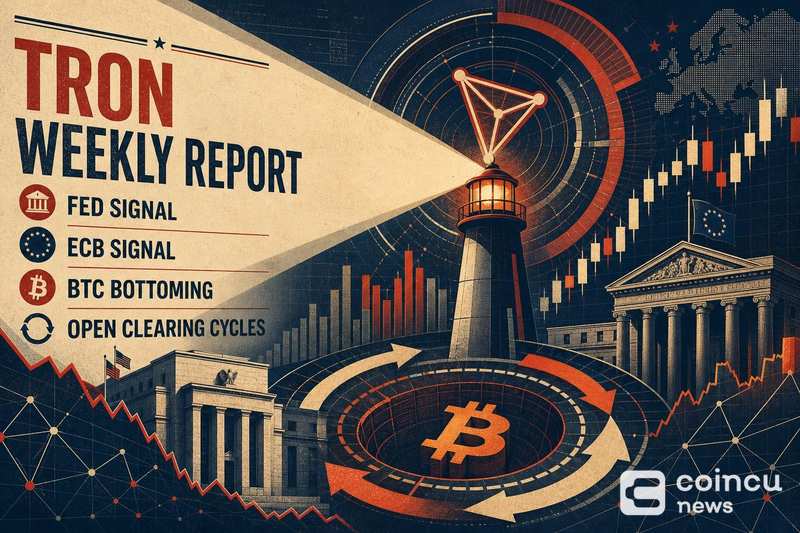
The weekly report, published via RootData, positions central bank messaging as the leading macro catalyst for the period. Rather than announcing a formal joint action, the report points to parallel signaling from both institutions as setting risk sentiment for digital assets. For related coverage, see TRON Weekly Report: Soft CPI, Loose Expectations, and PlutonAI.
Fed and ECB Signal Sets the Weekly Macro Tone
The TRON weekly report leads with the Federal Reserve and European Central Bank as the primary macro drivers. The framing suggests both institutions released forward guidance or liquidity-related signals within the same reporting window, creating a combined effect on market expectations. For related coverage, see Russia to Monitor Crypto Transactions Above 60,000 Rubles.
The report does not claim formal coordination between the Fed and ECB. Instead, it treats the timing overlap as meaningful for crypto markets, where traders often react to perceived shifts in global monetary conditions. The distinction matters: parallel dovish or hawkish signals from two major central banks carry different weight than a single institution acting alone.
Why Crypto Markets Noticed
Bitcoin and broader crypto assets tend to respond to changes in rate expectations and liquidity conditions. When the Fed and ECB signal in the same direction within a short window, it amplifies the perceived shift in the macro environment. The weekly report uses this as its opening frame, suggesting the dual signal influenced short-term BTC price structure.
This pattern of central bank signals driving crypto sentiment has been a recurring theme in recent TRON weekly reports. A previous TRON weekly report covering soft CPI data and loose expectations similarly framed macro indicators as key crypto catalysts.
Why the Report Says BTC May Be Bottoming
The headline’s claim that BTC is “starting to bottom out” is presented as a thesis within the weekly report, not a confirmed market reversal. The report uses the central bank signal context to argue that macro conditions may be shifting in favor of risk assets.
Bottoming Thesis
A bottoming argument in crypto typically relies on a combination of price structure, on-chain accumulation patterns, sentiment indicators, and macro tailwinds. The TRON weekly report appears to tie its BTC bottoming thesis to the Fed-ECB signal overlap, suggesting that easing expectations could provide a floor for Bitcoin’s price.
The Fear and Greed Index, a widely watched sentiment gauge, is one metric commonly used to assess whether markets have reached extreme pessimism levels consistent with a bottom. Depressed sentiment readings, when combined with improving macro signals, often form the basis for bottoming arguments.
What Could Invalidate It
A bottoming thesis can be invalidated by several factors: unexpected hawkish central bank pivots, deteriorating on-chain metrics, or a broader risk-off event that overrides monetary policy signals. The report’s thesis depends heavily on the Fed and ECB following through on their signaled direction.
Market conditions in the broader crypto space remain mixed. Solana market FUD recently hit 2026 highs while trading volume fell to yearly lows, illustrating that not all digital assets are responding uniformly to macro signals.
Open Clearing Protocol Cycles Explained
The most technical element of the TRON weekly report is its detailed explanation of open clearing protocol cycles. This concept relates to how decentralized or transparent settlement mechanisms move through distinct operational phases.
How the Cycle Works
An open clearing protocol refers to a settlement system where transaction clearing rules and states are publicly verifiable, as opposed to traditional closed clearing houses. The “cycle” describes the progression through phases: initiation, matching, netting, settlement, and finalization.
Each phase carries different risk profiles and liquidity requirements. During the netting phase, offsetting positions are consolidated, reducing the total volume of assets that must physically settle. The finalization phase confirms that all obligations have been met and the cycle is complete.
In blockchain contexts, open clearing protocols can operate on-chain, making each phase auditable. This transparency is a key differentiator from traditional financial clearing, where the process is opaque to outside observers.
Why the Cycle Matters Now
The TRON weekly report connects open clearing cycles to the current market environment by suggesting that understanding these mechanisms helps traders and institutions assess settlement risk during volatile periods. When central bank signals shift market dynamics, clearing cycle timing can affect liquidity availability.
Security considerations also remain relevant in the protocol layer. Recent incidents like the Injective npm package attack exposing wallet private keys underscore the importance of transparent, auditable infrastructure in the crypto ecosystem.
How Macro Signals, BTC Structure and Protocol Cycles Connect
The TRON weekly report bundles these three topics deliberately. The logic flows from macro trigger to market response to infrastructure context: central bank signals shift expectations, those expectations influence BTC’s price structure and bottoming thesis, and open clearing protocol cycles determine how that activity settles through the system.
This framing positions the weekly report as more than a market commentary. It attempts to connect policy-level developments to protocol-level mechanics, giving readers a vertical view from macro conditions down to settlement infrastructure.
The synthesis is relevant for institutional participants who must consider both directional market risk and operational clearing risk simultaneously. As exchanges expand into new trading products, understanding clearing cycles becomes increasingly practical rather than purely theoretical.
FAQ: Key Questions From the TRON Weekly Report
Did the Federal Reserve and ECB Formally Coordinate Their Signals?
No. The weekly report highlights parallel signaling from both institutions within the same time window, not a formal joint action. The significance lies in the timing overlap and its combined effect on market sentiment, not in any announced coordination.
What Does “BTC Bottoming” Actually Mean?
A bottoming process refers to a period where Bitcoin’s price stabilizes after a decline and begins forming a base for potential recovery. It does not guarantee an immediate reversal. The report presents this as a developing thesis tied to macro conditions, not a confirmed trend change.
What Is an Open Clearing Protocol Cycle?
It is the sequence of phases that a transparent, publicly verifiable settlement system moves through when processing transactions: from initiation through matching, netting, settlement, and finalization. In blockchain contexts, these phases can be audited on-chain, distinguishing them from traditional opaque clearing systems.
Where Can I Read the Full TRON Weekly Report?
The report referenced in this article is available through RootData’s news section, which aggregates industry publications and project updates.
Disclaimer: This article is for informational purposes only and does not constitute financial or investment advice. Cryptocurrency and digital asset markets carry significant risk. Always do your own research before making decisions.
No tags available.


Other Posts








- China, US Conclude Trade Talks with Focus on Cooperation
- Crypto Weekly: NYSE Backs OKX, Kraken Gets Fed Access, BTC Sells
- Court Upholds Fed’s Rejection of Custodia Bank’s Request
- Former CFO Convicted for $35M Fraudulent Crypto Investment
- DeriW Launches Edge Hour Trading Competition Platform for Derivatives Traders
- Michael Saylor Denies Bitcoin Sell-Off Amid Large BTC Transfer
- Buy Dogecoin on eToro: Step-by-Step Guide for Beginners (2024)
- Kazakhstan Explores Crypto Reserves Backed by National Funds
- JPMorgan Increases Holdings in BlackRock’s Bitcoin ETF
- Nordea Bank Introduces Bitcoin ETP Trading for Nordic Customers
- XRP Spot ETF Launches on Nasdaq Amid Market Fluctuations
- Peter Schiff Challenges Michael Saylor on MSTR’s Business Model
- Thailand Orders Worldcoin to Delete 1.2 Million Biometric Records
- UK Proposes New DeFi Tax Framework to Ease User Burden
- WLFI Under Fire: Analyst Warns Hyperliquid Could Be Next
- Ancient Ethereum Whale Moves $1.19 Billion After Decade
- BlackRock Receives Large Crypto Transfers from Coinbase
- SEC Scrutiny on ALT5 Sigma’s Leadership Disclosure Timing
- Yala Injects $5.5 Million Amid Recovery Efforts
- Radiant Capital Faces $50M Loss in Major Security Breach
- China, US Conclude Trade Talks with Focus on Cooperation
- Crypto Weekly: NYSE Backs OKX, Kraken Gets Fed Access, BTC Sells
- Court Upholds Fed’s Rejection of Custodia Bank’s Request
- Former CFO Convicted for $35M Fraudulent Crypto Investment
- DeriW Launches Edge Hour Trading Competition Platform for Derivatives Traders
- Michael Saylor Denies Bitcoin Sell-Off Amid Large BTC Transfer
- Buy Dogecoin on eToro: Step-by-Step Guide for Beginners (2024)
- Kazakhstan Explores Crypto Reserves Backed by National Funds
- JPMorgan Increases Holdings in BlackRock’s Bitcoin ETF
- Nordea Bank Introduces Bitcoin ETP Trading for Nordic Customers
- XRP Spot ETF Launches on Nasdaq Amid Market Fluctuations
- Peter Schiff Challenges Michael Saylor on MSTR’s Business Model
- Thailand Orders Worldcoin to Delete 1.2 Million Biometric Records
- UK Proposes New DeFi Tax Framework to Ease User Burden
- WLFI Under Fire: Analyst Warns Hyperliquid Could Be Next
- Ancient Ethereum Whale Moves $1.19 Billion After Decade
- BlackRock Receives Large Crypto Transfers from Coinbase
- SEC Scrutiny on ALT5 Sigma’s Leadership Disclosure Timing
- Yala Injects $5.5 Million Amid Recovery Efforts
- Radiant Capital Faces $50M Loss in Major Security Breach
- China, US Conclude Trade Talks with Focus on Cooperation
- Crypto Weekly: NYSE Backs OKX, Kraken Gets Fed Access, BTC Sells
- Court Upholds Fed’s Rejection of Custodia Bank’s Request
- Former CFO Convicted for $35M Fraudulent Crypto Investment
- DeriW Launches Edge Hour Trading Competition Platform for Derivatives Traders
- Michael Saylor Denies Bitcoin Sell-Off Amid Large BTC Transfer
- Buy Dogecoin on eToro: Step-by-Step Guide for Beginners (2024)
- Kazakhstan Explores Crypto Reserves Backed by National Funds
- JPMorgan Increases Holdings in BlackRock’s Bitcoin ETF
- Nordea Bank Introduces Bitcoin ETP Trading for Nordic Customers
- XRP Spot ETF Launches on Nasdaq Amid Market Fluctuations
- Peter Schiff Challenges Michael Saylor on MSTR’s Business Model
- Thailand Orders Worldcoin to Delete 1.2 Million Biometric Records
- UK Proposes New DeFi Tax Framework to Ease User Burden
- WLFI Under Fire: Analyst Warns Hyperliquid Could Be Next
- Ancient Ethereum Whale Moves $1.19 Billion After Decade
- BlackRock Receives Large Crypto Transfers from Coinbase
- SEC Scrutiny on ALT5 Sigma’s Leadership Disclosure Timing
- Yala Injects $5.5 Million Amid Recovery Efforts
- Radiant Capital Faces $50M Loss in Major Security Breach

TRON Weekly Report: Fed-ECB Signal, BTC Bottoming, Open Clearing Cycles

Binance Stocks to Open Pre-Issuance Limit-Order Trading for SK hynix ADR


Bitcoin Suisse Advances Middle East Expansion, Receives Financial Services Permission in Abu Dhabi