JustLend DAO has completed its fourth JST buyback and burn, lifting cumulative JST deflation past 17% of total supply and marking the latest step in a token-reduction program the TRON-based lending protocol began late last year.
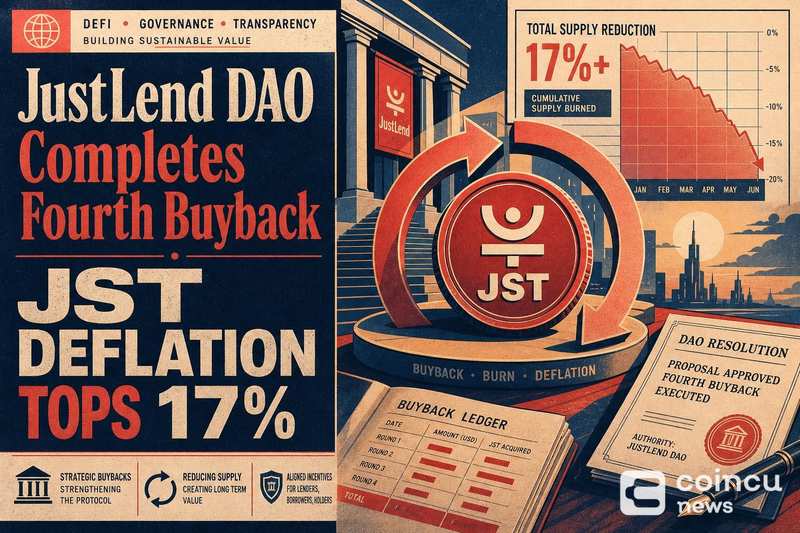
The protocol said the fourth round was carried out on July 17, 2026 (SGT), continuing a quarterly cadence set when the community first approved the buyback-and-burn framework. The update is a concrete treasury action rather than a new proposal, extending a strategy that steadily removes JST from circulation. For related coverage, see BMAG Brings a Full Trading Card Expo to Bitcoin Asia 2026.
The round retired a large tranche of tokens funded by protocol revenue and stablecoin fees. According to the official post, the burn was split into 248,357,799 JST repurchased with Q2 2026 treasury funds and 106,663,731.97 JST bought using USDJ stability fees, drawing on $10,281,441 in JustLend Q2 2026 net income, JustLend DAO said. For related coverage, see New Wallet Withdraws 10,000 ETH From Binance, Stakes Full Amount.
What Happened in JustLend DAO’s Fourth Buyback and Burn
The fourth round removed 355,021,530.97 JST, valued in the announcement at about $34,594,686, or roughly 3.59% of total supply. JustLend DAO framed the burn as a completed action, not a pending vote.
JustLend DAO operates one of the larger lending markets in the TRON ecosystem, and the burn program sits alongside product expansions such as its recently launched U-Market lending. The reviewed platform is documented in more detail in this overview of JustLend.
The mechanism converts protocol earnings into open-market demand for JST before destroying the purchased tokens. In this round that meant deploying roughly $34.59 million to acquire the JST that was then permanently retired, linking the protocol’s operating performance directly to supply reduction.
The completion was also confirmed through the DAO’s official channel on X, which restated the headline figure and the fourth-round sequencing.
📢Announcement: $JST Buyback & Burn Phase 4 Completed
Following the community-approved JST buyback & burn proposal, #JustLendDAO has successfully completed the fourth $JST buyback & burn on July 17, 2026 (SGT).
✅Total $JST burned: 355,021,530.97 JST
Including:
• 248,357,799… pic.twitter.com/XCz3lZOFIa— JUST DAO (@DeFi_JUST) July 17, 2026
Source: @DeFi_JUST on X
How JST Cumulative Deflation Moved Above 17%
Cumulative deflation measures how much of JST’s total supply has been permanently destroyed since the program began. After this round, the DAO said total JST burned reached 1,711,249,863 tokens, equal to 17.29% of total supply.
Unlike a temporary token lock or a staking mechanism, a burn is irreversible: the destroyed JST leaves supply for good. That distinction is why cumulative burn totals, rather than transient balances, are the metric the DAO reports each quarter.
The figure is cumulative, so each quarterly burn adds to the running total rather than resetting it. The fourth round’s supply reduction is the increment that pushed the running tally across the 17% threshold.
Scaled against the market, the 1,711,249,863 JST retired so far exceeds a fifth of the roughly 8.19 billion JST still in circulation, a comparison the burn coverage has largely left implicit. The single fourth round alone accounted for about 3.59% of total supply, showing that individual quarters can move the deflation needle meaningfully.
JST currently trades at $0.096483, down about 1.7% over 24 hours, with a market capitalization near $790 million and 24-hour volume around $27 million. The burn program is subtracting from that base one quarter at a time.
Why the Latest JST Burn Matters for JustLend DAO and Token Holders
Repeated buybacks funded by protocol revenue signal a continuing tokenomics policy rather than a one-off gesture. That recurring cadence is what shapes market narrative around a token, because holders can model future supply reduction instead of reacting to a single event.
Burns matter to supply perception because they permanently remove tokens, tightening the circulating base that future demand competes for. A numbered milestone like the 17% threshold is more legible to the market than an unlabeled burn update, giving observers a fixed reference point for how far the program has progressed.
The dual funding structure is worth noting for holders. Because the round drew on both Q2 treasury profit and USDJ stability fees, future burns are tied to two revenue streams at once: lending profitability and stablecoin usage, rather than a single fixed budget.
The $203 million in outstanding borrows against roughly $3.25 billion locked shows a large deposit base relative to active loans, the kind of scale that generates the fee income feeding the burn. It is the protocol’s ongoing activity, not a one-time treasury drawdown, that sustains the quarterly rounds.
The context is protocol scale. JustLend’s total value locked stands at about $3.25 billion, with borrowed value near $203 million, underlining that the revenue funding these burns comes from an active lending market. JustLend DAO has also tuned incentives elsewhere, including adjustments to its USDD market mining rewards.
What to Watch After JustLend DAO’s Fourth Burn
The program traces back to a community vote approved on October 21, 2025 (SGT), which burned 30% of the allocation immediately and scheduled the remaining 70% across four quarters, according to the approval announcement. With four rounds now complete, the original quarterly schedule is near its end.
That structure means the fourth round effectively completes the staged rollout of the 70% tranche that followed the initial 30% burn. Any continuation beyond it would require fresh governance signaling rather than the mandate already in place, making the DAO’s next communication the key variable.
Readers tracking the story can watch for whether the DAO signals a renewed or extended burn mandate, since the current framework covered a defined number of quarters. Future burn size will hinge on protocol net income, as this round did.
The pace also bears watching. Four rounds have carried cumulative deflation to 17.29%, so the marginal impact of any fifth round would build on an already reduced base, meaning the same token amount would represent a larger share of what remains.
Broader market conditions remain cautious, with the Crypto Fear & Greed Index at 29, in Fear territory. The most reliable way to follow JST deflation is JustLend DAO’s own announcements, which disclose each round’s token amount, dollar value, and updated cumulative total.
Independent discussion of the event has so far been concentrated in the DAO’s official post and reposted summaries rather than broad debate, so the primary announcements remain the highest-signal record of each round’s figures.
FAQ: JustLend DAO Buyback and Burn Explained
What does a buyback and burn mean? The DAO uses protocol revenue and fees to repurchase JST from the market, then permanently destroys those tokens so they can never re-enter circulation.
What is cumulative JST deflation? It is the total share of JST supply removed across all burns to date, which the DAO now puts at 17.29%.
Was this JustLend DAO’s first burn? No. It is the fourth round under a framework the community approved in October 2025, with earlier burns already reducing supply.
Where does the money for the buyback come from? This round used $10,281,441 in JustLend Q2 2026 net income alongside USDJ stability fees, meaning the tokens were bought with protocol revenue rather than newly issued funds.
Why does the 17% figure matter? It is a fixed, cumulative milestone that shows how far the program has cut supply, giving the market a clear reference point rather than an isolated round-by-round number.
Disclaimer: This article is for informational purposes only and does not constitute financial or investment advice. Cryptocurrency and digital asset markets carry significant risk. Always do your own research before making decisions.
No tags available.


Other Posts








- China, US Conclude Trade Talks with Focus on Cooperation
- Crypto Weekly: NYSE Backs OKX, Kraken Gets Fed Access, BTC Sells
- Court Upholds Fed’s Rejection of Custodia Bank’s Request
- Former CFO Convicted for $35M Fraudulent Crypto Investment
- DeriW Launches Edge Hour Trading Competition Platform for Derivatives Traders
- Michael Saylor Denies Bitcoin Sell-Off Amid Large BTC Transfer
- Buy Dogecoin on eToro: Step-by-Step Guide for Beginners (2024)
- Kazakhstan Explores Crypto Reserves Backed by National Funds
- JPMorgan Increases Holdings in BlackRock’s Bitcoin ETF
- Nordea Bank Introduces Bitcoin ETP Trading for Nordic Customers
- XRP Spot ETF Launches on Nasdaq Amid Market Fluctuations
- Peter Schiff Challenges Michael Saylor on MSTR’s Business Model
- Thailand Orders Worldcoin to Delete 1.2 Million Biometric Records
- UK Proposes New DeFi Tax Framework to Ease User Burden
- WLFI Under Fire: Analyst Warns Hyperliquid Could Be Next
- Ancient Ethereum Whale Moves $1.19 Billion After Decade
- BlackRock Receives Large Crypto Transfers from Coinbase
- SEC Scrutiny on ALT5 Sigma’s Leadership Disclosure Timing
- Yala Injects $5.5 Million Amid Recovery Efforts
- Radiant Capital Faces $50M Loss in Major Security Breach
- China, US Conclude Trade Talks with Focus on Cooperation
- Crypto Weekly: NYSE Backs OKX, Kraken Gets Fed Access, BTC Sells
- Court Upholds Fed’s Rejection of Custodia Bank’s Request
- Former CFO Convicted for $35M Fraudulent Crypto Investment
- DeriW Launches Edge Hour Trading Competition Platform for Derivatives Traders
- Michael Saylor Denies Bitcoin Sell-Off Amid Large BTC Transfer
- Buy Dogecoin on eToro: Step-by-Step Guide for Beginners (2024)
- Kazakhstan Explores Crypto Reserves Backed by National Funds
- JPMorgan Increases Holdings in BlackRock’s Bitcoin ETF
- Nordea Bank Introduces Bitcoin ETP Trading for Nordic Customers
- XRP Spot ETF Launches on Nasdaq Amid Market Fluctuations
- Peter Schiff Challenges Michael Saylor on MSTR’s Business Model
- Thailand Orders Worldcoin to Delete 1.2 Million Biometric Records
- UK Proposes New DeFi Tax Framework to Ease User Burden
- WLFI Under Fire: Analyst Warns Hyperliquid Could Be Next
- Ancient Ethereum Whale Moves $1.19 Billion After Decade
- BlackRock Receives Large Crypto Transfers from Coinbase
- SEC Scrutiny on ALT5 Sigma’s Leadership Disclosure Timing
- Yala Injects $5.5 Million Amid Recovery Efforts
- Radiant Capital Faces $50M Loss in Major Security Breach
- China, US Conclude Trade Talks with Focus on Cooperation
- Crypto Weekly: NYSE Backs OKX, Kraken Gets Fed Access, BTC Sells
- Court Upholds Fed’s Rejection of Custodia Bank’s Request
- Former CFO Convicted for $35M Fraudulent Crypto Investment
- DeriW Launches Edge Hour Trading Competition Platform for Derivatives Traders
- Michael Saylor Denies Bitcoin Sell-Off Amid Large BTC Transfer
- Buy Dogecoin on eToro: Step-by-Step Guide for Beginners (2024)
- Kazakhstan Explores Crypto Reserves Backed by National Funds
- JPMorgan Increases Holdings in BlackRock’s Bitcoin ETF
- Nordea Bank Introduces Bitcoin ETP Trading for Nordic Customers
- XRP Spot ETF Launches on Nasdaq Amid Market Fluctuations
- Peter Schiff Challenges Michael Saylor on MSTR’s Business Model
- Thailand Orders Worldcoin to Delete 1.2 Million Biometric Records
- UK Proposes New DeFi Tax Framework to Ease User Burden
- WLFI Under Fire: Analyst Warns Hyperliquid Could Be Next
- Ancient Ethereum Whale Moves $1.19 Billion After Decade
- BlackRock Receives Large Crypto Transfers from Coinbase
- SEC Scrutiny on ALT5 Sigma’s Leadership Disclosure Timing
- Yala Injects $5.5 Million Amid Recovery Efforts
- Radiant Capital Faces $50M Loss in Major Security Breach

New Wallet Withdraws 7,000 ETH From Binance and Stakes $13.46M

UK parliamentary digital assets group launches inquiry into crypto banking access

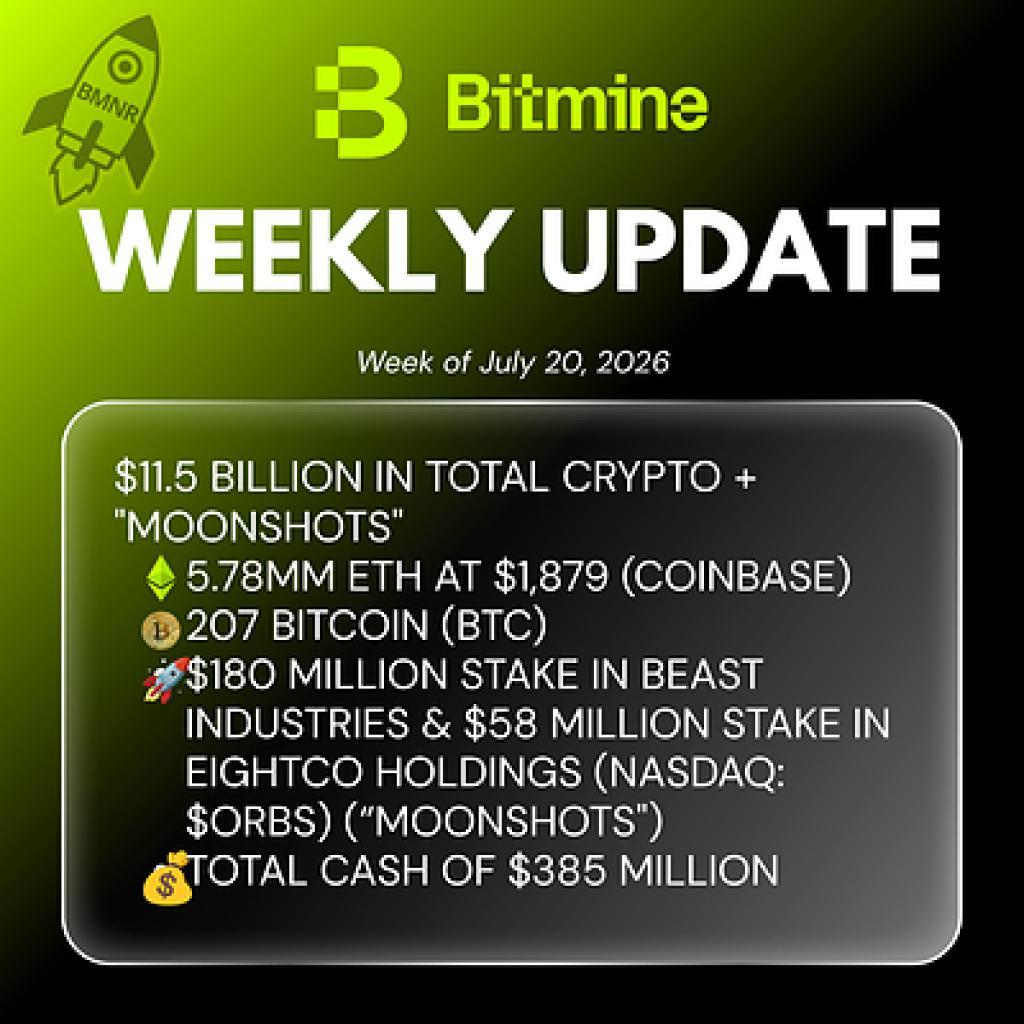
Bitmine Immersion Technologies (BMNR) Announces ETH Holdings Reach 5.78 Million Tokens, and Total Crypto and Total Cash Holdings of $11.5 Billion

GLOBAL MEDIA PROCUREMENT: THE 500-YEAR YIXING ZISHA TEAPOTS PARADIGM