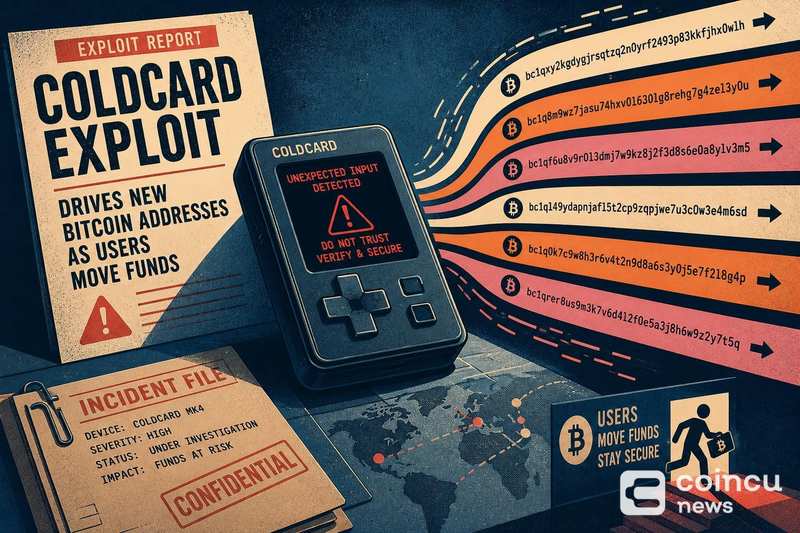
Coldcard exploit report drives new Bitcoin addresses as users move funds
A reported Coldcard exploit has been linked to a jump in new Bitcoin addresses, as holders appear to move funds to fresh wallets in a precautionary self-custody response. The scope of the incident and the size of the address increase remain only partially verified.
What triggered the reported Coldcard-driven wallet migration
The reported issue centers on a seed-generation flaw in Coldcard hardware wallets, detailed in a seed-generation warning from Coinkite, the device’s maker. For related coverage, see Exploit Drains Bitcoin Lightning Payment Servers: What Happened.
Coverage of the incident, including its knock-on effects, was summarized in reporting from Cointelegraph. Coincu has separately tracked how the exploit raised questions about air-gapped wallet security.
When a wallet’s seed generation is called into question, the immediate defensive action is to move Bitcoin to a newly generated address whose keys were not produced by the affected process. That rotation is the mechanism the headline points to.
What is confirmed, and what still lacks proof
The available research on this story carries a partial verification status and low confidence. It contains no confirmed count of affected wallets and no verified figure for Bitcoin at risk.
The reported rise in new Bitcoin addresses has not been tied to a dated, named on-chain dataset in the material reviewed. Readers should treat the address-jump claim as unconfirmed until independent on-chain data supports it.
It is worth distinguishing the vendor’s own statement, the media summary of the incident, and any later on-chain interpretation. Loss estimates reported elsewhere, including Coincu’s tracking of exploit losses reaching $88 million and a later figure approaching $114 million, remain estimates rather than settled totals.
Why new Bitcoin addresses can rise when holders rotate funds
This is a security story, not a demand story. A jump in new addresses can reflect existing holders creating fresh wallets and moving coins, rather than new buyers entering the market.
Each precautionary transfer generates one or more new addresses as users rotate UTXOs into keys they trust. More addresses in this context signal defensive activity, not necessarily stronger demand or capital inflows.
If many holders move coins at once, the concentrated activity can raise fee pressure and add mempool congestion. On-chain providers such as CryptoQuant have examined the on-chain repercussions of the Coldcard incident.
Why the episode matters beyond one hardware wallet vendor
A credible exploit report can reprice trust in self-custody tooling, even for devices marketed on their security. The question extends past one vendor to how holders vet the wallets that generate their keys.
Funds, treasuries, and high-net-worth holders watch hardware-wallet operational risk closely because a seed-generation weakness affects key custody directly. Some observers have argued the episode could boost demand for regulated Bitcoin exposure as an alternative to self-custody.
Absent verified price data, the significance here rests on custody implications rather than any claimed market reaction. Broader effects on ETF flows or Bitcoin’s price cannot be asserted from the current evidence.
What holders should watch next
Key triggers include a further vendor postmortem or update from Coinkite, fresh and dated on-chain address data, and any measurable fee or mempool impact from concentrated migration.
- What is the Coldcard exploit and who may be affected? The reported issue is a seed-generation flaw in Coldcard hardware wallets, per the vendor’s warning; the precise affected cohort has not been fully verified in available material.
- Does a jump in new Bitcoin addresses mean new buyers entered the market? Not necessarily. Address growth driven by wallet rotation reflects existing holders moving funds, not confirmed new demand.
- What should holders verify before moving funds after a hardware-wallet alert? Confirm the vendor’s official guidance and ensure any new address is generated by an unaffected process before transferring coins.
Disclaimer: This article is for informational purposes only and does not constitute financial or investment advice. Cryptocurrency and digital asset markets carry significant risk. Always do your own research before making decisions.
No tags available.


Other Posts





- China, US Conclude Trade Talks with Focus on Cooperation
- Crypto Weekly: NYSE Backs OKX, Kraken Gets Fed Access, BTC Sells
- Court Upholds Fed’s Rejection of Custodia Bank’s Request
- Former CFO Convicted for $35M Fraudulent Crypto Investment
- DeriW Launches Edge Hour Trading Competition Platform for Derivatives Traders
- Michael Saylor Denies Bitcoin Sell-Off Amid Large BTC Transfer
- Buy Dogecoin on eToro: Step-by-Step Guide for Beginners (2024)
- Kazakhstan Explores Crypto Reserves Backed by National Funds
- JPMorgan Increases Holdings in BlackRock’s Bitcoin ETF
- Nordea Bank Introduces Bitcoin ETP Trading for Nordic Customers
- XRP Spot ETF Launches on Nasdaq Amid Market Fluctuations
- Peter Schiff Challenges Michael Saylor on MSTR’s Business Model
- Thailand Orders Worldcoin to Delete 1.2 Million Biometric Records
- UK Proposes New DeFi Tax Framework to Ease User Burden
- WLFI Under Fire: Analyst Warns Hyperliquid Could Be Next
- Ancient Ethereum Whale Moves $1.19 Billion After Decade
- BlackRock Receives Large Crypto Transfers from Coinbase
- SEC Scrutiny on ALT5 Sigma’s Leadership Disclosure Timing
- Yala Injects $5.5 Million Amid Recovery Efforts
- Radiant Capital Faces $50M Loss in Major Security Breach
- China, US Conclude Trade Talks with Focus on Cooperation
- Crypto Weekly: NYSE Backs OKX, Kraken Gets Fed Access, BTC Sells
- Court Upholds Fed’s Rejection of Custodia Bank’s Request
- Former CFO Convicted for $35M Fraudulent Crypto Investment
- DeriW Launches Edge Hour Trading Competition Platform for Derivatives Traders
- Michael Saylor Denies Bitcoin Sell-Off Amid Large BTC Transfer
- Buy Dogecoin on eToro: Step-by-Step Guide for Beginners (2024)
- Kazakhstan Explores Crypto Reserves Backed by National Funds
- JPMorgan Increases Holdings in BlackRock’s Bitcoin ETF
- Nordea Bank Introduces Bitcoin ETP Trading for Nordic Customers
- XRP Spot ETF Launches on Nasdaq Amid Market Fluctuations
- Peter Schiff Challenges Michael Saylor on MSTR’s Business Model
- Thailand Orders Worldcoin to Delete 1.2 Million Biometric Records
- UK Proposes New DeFi Tax Framework to Ease User Burden
- WLFI Under Fire: Analyst Warns Hyperliquid Could Be Next
- Ancient Ethereum Whale Moves $1.19 Billion After Decade
- BlackRock Receives Large Crypto Transfers from Coinbase
- SEC Scrutiny on ALT5 Sigma’s Leadership Disclosure Timing
- Yala Injects $5.5 Million Amid Recovery Efforts
- Radiant Capital Faces $50M Loss in Major Security Breach
- China, US Conclude Trade Talks with Focus on Cooperation
- Crypto Weekly: NYSE Backs OKX, Kraken Gets Fed Access, BTC Sells
- Court Upholds Fed’s Rejection of Custodia Bank’s Request
- Former CFO Convicted for $35M Fraudulent Crypto Investment
- DeriW Launches Edge Hour Trading Competition Platform for Derivatives Traders
- Michael Saylor Denies Bitcoin Sell-Off Amid Large BTC Transfer
- Buy Dogecoin on eToro: Step-by-Step Guide for Beginners (2024)
- Kazakhstan Explores Crypto Reserves Backed by National Funds
- JPMorgan Increases Holdings in BlackRock’s Bitcoin ETF
- Nordea Bank Introduces Bitcoin ETP Trading for Nordic Customers
- XRP Spot ETF Launches on Nasdaq Amid Market Fluctuations
- Peter Schiff Challenges Michael Saylor on MSTR’s Business Model
- Thailand Orders Worldcoin to Delete 1.2 Million Biometric Records
- UK Proposes New DeFi Tax Framework to Ease User Burden
- WLFI Under Fire: Analyst Warns Hyperliquid Could Be Next
- Ancient Ethereum Whale Moves $1.19 Billion After Decade
- BlackRock Receives Large Crypto Transfers from Coinbase
- SEC Scrutiny on ALT5 Sigma’s Leadership Disclosure Timing
- Yala Injects $5.5 Million Amid Recovery Efforts
- Radiant Capital Faces $50M Loss in Major Security Breach


TD Cowen Says SEC May Start Crypto Rulemaking With Token Safe Harbor

ForumPay Expands Payment Infrastructure with New Card and Bank Transfer Acceptance Solution

Newest Assets, Improved User Promotions & Much Greater Crypto Experience_ Xxkk Trade Exchange Reinforces Its Trade Environment