Best Places to Buy Bitcoin Without ID in 2026: 7 Options and Trade-Offs
Best Places to Buy Bitcoin Without ID in 2026: 7 Options and Trade-Offs
Updated July 8, 2026
Quick Answer
If you want the short version, the best-known ways to buy Bitcoin without ID in 2026 include Bisq, RoboSats, Peach Bitcoin, Hodl Hodl, Vexl, LocalCoinSwap, and some Bitcoin ATM or voucher-style options depending on local rules.
But this topic needs a stricter warning than most list pages include:
- “without ID” does not always mean “without any limits or conditions”
- platform rules can change by jurisdiction, payment method, and transaction size
- privacy-friendly buying does not remove legal, tax, or counterparty risk
So the real decision is not only where you can buy Bitcoin without ID. It is which method gives you the privacy level, payment flow, and trade protection you actually understand.
Important Caveat Before You Compare Options
This article is not a guide to evading the law.
Availability of no-KYC or low-KYC Bitcoin buying can vary by country, local regulation, payment rail, and trade size. Some services explicitly state that no-KYC access is only available under certain thresholds or where local law allows it. Readers should verify local compliance obligations before using any method listed here.
That said, there is still legitimate search intent here because privacy-preserving, peer-to-peer Bitcoin buying remains a real product category.
How We Chose These Options
This list focuses on methods and platforms that publicly describe themselves as peer-to-peer, non-custodial, privacy-focused, or usable without standard centralized exchange identity verification.
These seven were chosen based on:
- clear public positioning around private or P2P Bitcoin buying
- official documentation or product claims explaining how trades work
- practical relevance for buyers rather than only ideological branding
- visible trade protection models such as escrow, multisig, or trusted networks
This is a risk-aware comparison, not a recommendation to use the most anonymous method possible in every situation.
Quick Comparison
| Option | Best for | Model | Strongest point | Main trade-off |
|---|---|---|---|---|
| Bisq | desktop users who want a deeply decentralized approach | P2P desktop exchange | strong privacy and no-KYC positioning | higher learning curve |
| RoboSats | Lightning-native private trades | P2P marketplace | simple private trading flow | best fit for users comfortable with Lightning and peer-to-peer workflow |
| Peach Bitcoin | mobile-first P2P users | self-custodial P2P marketplace | no registration flow and multisig escrow model | compliance limits may vary by jurisdiction and thresholds |
| Hodl Hodl | users who want global P2P offers with multisig escrow | P2P marketplace | non-custodial multisig trade structure | counterparty and payment-method risk still matter |
| Vexl | users who prefer trust-network P2P discovery | private marketplace app | privacy-focused social trading model | depends on trusted network and local contacts |
| LocalCoinSwap | users who want broader P2P market variety | P2P marketplace | wide marketplace structure | quality varies by vendor and payment method |
| Bitcoin ATMs or vouchers | local in-person or voucher buyers | physical / retail channel | convenience for some buyers | fees, availability, and verification rules vary a lot |
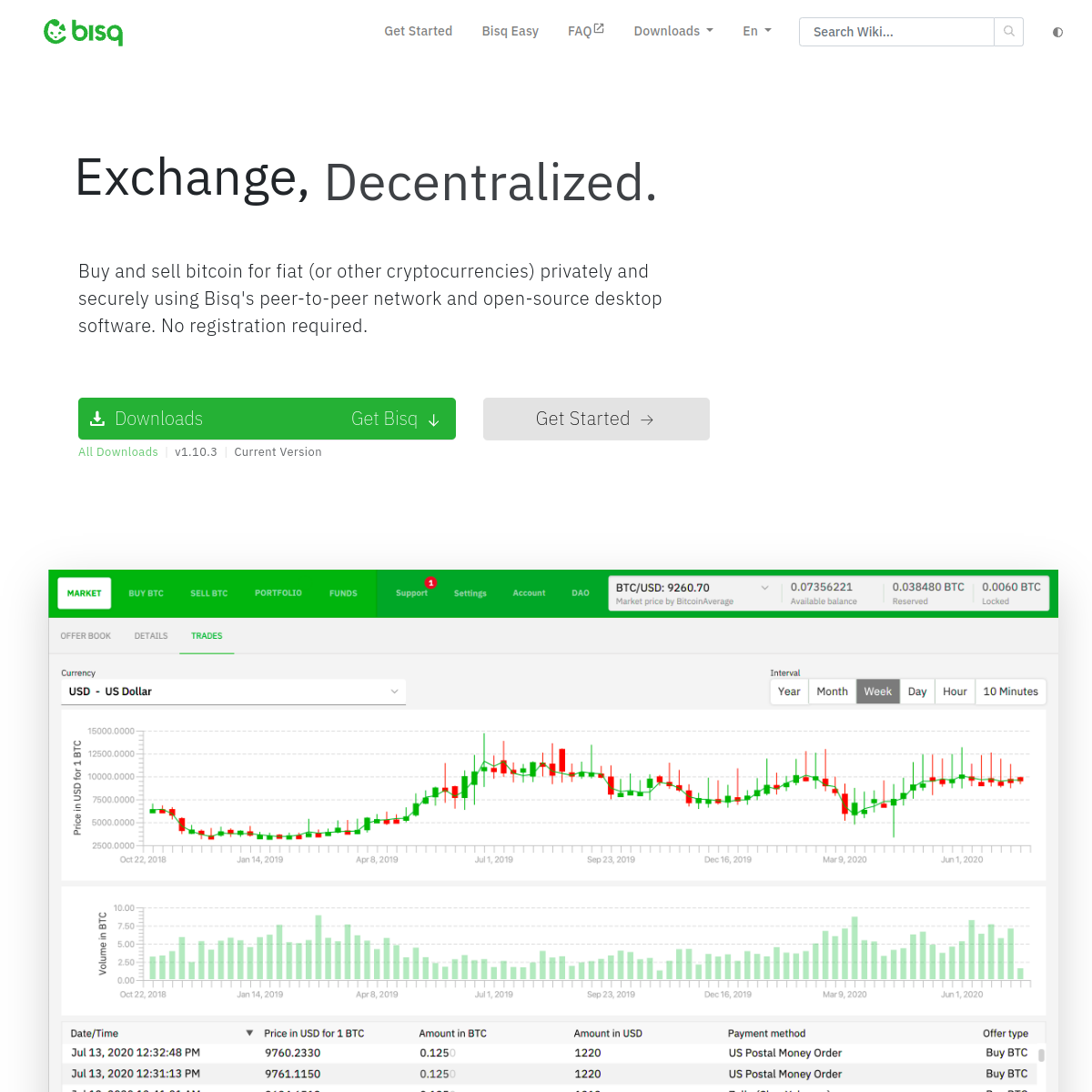
1. Bisq
Bisq remains one of the strongest answers for users who mean “without ID” in the strictest peer-to-peer sense.
Bisq’s official site describes it as a decentralized Bitcoin exchange where users can buy and sell bitcoin privately, without registration or identity verification. That positioning makes it one of the most consistent no-KYC names in the category.
Why it made the list:
- one of the clearest privacy-first Bitcoin buying products
- decentralized model reduces dependence on a central operator
- long-standing relevance in the peer-to-peer Bitcoin world
What looks strongest in 2026:
- strong no-KYC positioning
- desktop-first control
- good fit for users who want to avoid centralized exchange onboarding
What remains weaker:
- learning curve is higher than mainstream apps
- users still need to understand deposits, dispute flow, and payment-method risk
2. RoboSats
RoboSats is relevant because it offers a simpler private trading flow for users already comfortable with peer-to-peer Bitcoin buying.
Its official materials present it as a private exchange model without identity verification or account creation. That makes it especially relevant to users who want a more minimal trading flow than a heavyweight desktop exchange.
Why it made the list:
- explicit no-KYC identity
- strong privacy-first design
- useful for users comfortable with Lightning and P2P workflows
What looks strongest in 2026:
- focused product identity
- easier conceptually than some older decentralized exchange flows
- strong fit for privacy-conscious Bitcoin buyers
What remains weaker:
- still requires comfort with peer-to-peer execution
- not the easiest path for total beginners who have never used self-custody or Lightning tools
3. Peach Bitcoin
Peach Bitcoin is important because it tries to make private P2P Bitcoin buying feel more consumer-friendly.
Peach’s site says users can buy and sell bitcoin peer-to-peer with no registration and no verification, while staying self-custodial. At the same time, Peach’s FAQ also makes clear that compliance limits may apply in some cases and jurisdictions, which is exactly the kind of nuance many weak no-KYC listicles ignore.
Why it made the list:
- more approachable mobile-first experience
- self-custodial trade model
- explicit discussion of compliance thresholds in official FAQ material
What looks strongest in 2026:
- cleaner onboarding than many older P2P tools
- escrow-based trade protection
- useful for users who want privacy without a desktop-heavy workflow
What remains weaker:
- “no KYC” is not an unconditional promise everywhere
- availability and limits can depend on local rules
4. Hodl Hodl
Hodl Hodl remains relevant because it built its identity around global P2P Bitcoin trading with non-custodial multisig escrow.
Its official FAQ says trades occur directly between users and that the platform does not hold funds, while also stating that users do not need to complete verification to trade on the platform.
Why it made the list:
- long-standing P2P Bitcoin brand
- no-verification messaging is explicit in official materials
- multisig escrow model helps explain trade protection clearly
What looks strongest in 2026:
- global P2P structure
- strong fit for users who want payment-method flexibility
- clearer custody logic than many centralized alternatives
What remains weaker:
- users still face counterparty and payment rail risk
- privacy does not guarantee simplicity or low fraud exposure
5. Vexl
Vexl belongs in this comparison because it approaches private Bitcoin buying through a trusted social-marketplace model.
Its official site says the app lets users trade bitcoin peer-to-peer without KYC, using a private marketplace and anonymized communication, while not holding user funds or tracking purchases.
Why it made the list:
- very explicit privacy positioning
- distinct product model compared with classic escrow-based exchanges
- useful for users who prefer trusted-network discovery rather than fully open marketplaces
What looks strongest in 2026:
- private marketplace logic
- open-source positioning
- strong fit for people who prefer more social trust signals
What remains weaker:
- better fit where local network effects exist
- not every user wants to rely on a friends-and-friends marketplace model
6. LocalCoinSwap
LocalCoinSwap remains relevant because some users still want a broader open marketplace with many vendors and payment methods.
The trade-off is that broad marketplace flexibility increases the need for seller screening, escrow discipline, and careful review of payment-method terms.
Why it made the list:
- wide marketplace model
- useful for comparing offers across vendors
- relevant to users who want more payment-method variety
What looks strongest in 2026:
- broad listing environment
- multiple vendor choices
- useful when a user wants options rather than one fixed product flow
What remains weaker:
- vendor quality varies
- users must do more of their own due diligence
7. Bitcoin ATMs and Voucher-Style Options
The final category is not one platform but a real buying path that many users still search for.
Some Bitcoin ATMs, voucher providers, or retail purchase methods may allow lower-friction buying at certain thresholds or under local rules. In other places, these channels may still require phone verification, identity checks, or full compliance onboarding.
Why it made the list:
- still relevant in local search intent
- useful for in-person or cash-adjacent buyers
- often easier to understand than running a full P2P trade for first-time users
What looks strongest in 2026:
- convenience
- local access in some regions
- simple mental model for certain buyers
What remains weaker:
- fees can be high
- availability is inconsistent
- KYC rules vary significantly by jurisdiction and operator
Which Option Fits Different Buyers?
If you only want a quick chooser:
- choose Bisq if you want one of the strongest decentralized no-KYC options
- choose RoboSats if you want a more minimal private peer-to-peer flow
- choose Peach if you want a mobile-first self-custodial experience
- choose Hodl Hodl if you want a global P2P marketplace with multisig escrow
- choose Vexl if you prefer private marketplace discovery through trusted-network logic
- choose LocalCoinSwap if you want more vendor variety
- consider ATMs or voucher paths only after checking local rules and fees carefully
What Most “No ID Bitcoin” Pages Get Wrong
The biggest mistake is pretending privacy and risk move in the same direction.
They do not.
A more private buying method may also mean:
- less recourse
- more counterparty judgment required
- more payment-method risk
- less beginner-friendly UX
That is why the better question is not “How do I buy Bitcoin with zero friction and zero ID?” The better question is “Which trade-off am I actually willing to accept?”
FAQ
Can I still buy Bitcoin without ID in 2026?
In some contexts, yes. Peer-to-peer and privacy-focused methods still exist. But availability, limits, and legality can vary by jurisdiction, payment method, and trade size.
What is the safest way to buy Bitcoin without ID?
“Safest” depends on what risk you mean. Bisq and Hodl Hodl have stronger trade-structure logic than a random informal seller, while Peach and Vexl may feel easier for some users. None of these methods removes the need for due diligence.
Is no-KYC Bitcoin buying legal?
That depends on local law, platform scope, transaction size, and payment method. Some services explicitly note that no-KYC usage is only available where local law allows it or under certain thresholds.
Which option is best for beginners?
Peach and, in some cases, Vexl can feel more approachable than desktop-heavy tools. But beginners still need to understand self-custody, payment risk, and dispute mechanics before trading.
Final Takeaway
The best places to buy Bitcoin without ID in 2026 are not “secret exchanges.” They are mostly peer-to-peer or privacy-oriented trade environments with very different trade-offs.
Bisq, RoboSats, Peach, Hodl Hodl, Vexl, LocalCoinSwap, and some ATM or voucher paths are all worth understanding. But none should be judged only by the phrase “no KYC.” They should be judged by trade structure, self-custody, dispute protection, regional availability, and your own legal obligations.
References
- Bisq: https://bisq.info/
- Bisq network site: https://bisq.network/
- RoboSats: https://robosats.exchange/
- Peach Bitcoin: https://peachbitcoin.com/
- Peach web app: https://peachbitcoin.com/web-app/
- Peach account FAQ: https://peachbitcoin.com/faq/account/
- Peach trading FAQ: https://peachbitcoin.com/faq/trading/
- Hodl Hodl: https://hodlhodl.com/
- Hodl Hodl FAQ: https://hodlhodl.com/faq
- Vexl: https://vexl.it/
- LocalCoinSwap whitepaper: https://pwa-cdn.localcoinswap.com/public/LocalCoinSwap_whitepaper_v1.0.pdf
Internal Link Opportunities
- what is crypto custody: https://coincu.com/what-is-crypto-custody/
- hot wallet vs cold wallet: https://coincu.com/understanding-hot-wallets-and-cold-wallets/
- best crypto wallet: https://coincu.com/best-crypto-wallet/
- Bitcoin ETF or broader Bitcoin explainer page if available
Media Plan
Featured image:
- a neutral editorial grid showing P2P, escrow, mobile app, and ATM/voucher buying paths
Suggested inline media:
- Bisq homepage capture
- Peach no-registration or FAQ capture
- Hodl Hodl FAQ multisig explanation capture
Caption direction:
- emphasize privacy, trade model, and jurisdiction caveats
Disclosure
This article is for informational purposes only and does not constitute legal, tax, or investment advice. Readers are responsible for complying with local laws, payment-provider rules, and tax obligations before using any privacy-focused Bitcoin buying method.


Other Posts


- China, US Conclude Trade Talks with Focus on Cooperation
- Crypto Weekly: NYSE Backs OKX, Kraken Gets Fed Access, BTC Sells
- Court Upholds Fed’s Rejection of Custodia Bank’s Request
- Former CFO Convicted for $35M Fraudulent Crypto Investment
- DeriW Launches Edge Hour Trading Competition Platform for Derivatives Traders
- Michael Saylor Denies Bitcoin Sell-Off Amid Large BTC Transfer
- Buy Dogecoin on eToro: Step-by-Step Guide for Beginners (2024)
- Kazakhstan Explores Crypto Reserves Backed by National Funds
- JPMorgan Increases Holdings in BlackRock’s Bitcoin ETF
- Nordea Bank Introduces Bitcoin ETP Trading for Nordic Customers
- XRP Spot ETF Launches on Nasdaq Amid Market Fluctuations
- Peter Schiff Challenges Michael Saylor on MSTR’s Business Model
- Thailand Orders Worldcoin to Delete 1.2 Million Biometric Records
- UK Proposes New DeFi Tax Framework to Ease User Burden
- WLFI Under Fire: Analyst Warns Hyperliquid Could Be Next
- Ancient Ethereum Whale Moves $1.19 Billion After Decade
- BlackRock Receives Large Crypto Transfers from Coinbase
- SEC Scrutiny on ALT5 Sigma’s Leadership Disclosure Timing
- Yala Injects $5.5 Million Amid Recovery Efforts
- Radiant Capital Faces $50M Loss in Major Security Breach
- China, US Conclude Trade Talks with Focus on Cooperation
- Crypto Weekly: NYSE Backs OKX, Kraken Gets Fed Access, BTC Sells
- Court Upholds Fed’s Rejection of Custodia Bank’s Request
- Former CFO Convicted for $35M Fraudulent Crypto Investment
- DeriW Launches Edge Hour Trading Competition Platform for Derivatives Traders
- Michael Saylor Denies Bitcoin Sell-Off Amid Large BTC Transfer
- Buy Dogecoin on eToro: Step-by-Step Guide for Beginners (2024)
- Kazakhstan Explores Crypto Reserves Backed by National Funds
- JPMorgan Increases Holdings in BlackRock’s Bitcoin ETF
- Nordea Bank Introduces Bitcoin ETP Trading for Nordic Customers
- XRP Spot ETF Launches on Nasdaq Amid Market Fluctuations
- Peter Schiff Challenges Michael Saylor on MSTR’s Business Model
- Thailand Orders Worldcoin to Delete 1.2 Million Biometric Records
- UK Proposes New DeFi Tax Framework to Ease User Burden
- WLFI Under Fire: Analyst Warns Hyperliquid Could Be Next
- Ancient Ethereum Whale Moves $1.19 Billion After Decade
- BlackRock Receives Large Crypto Transfers from Coinbase
- SEC Scrutiny on ALT5 Sigma’s Leadership Disclosure Timing
- Yala Injects $5.5 Million Amid Recovery Efforts
- Radiant Capital Faces $50M Loss in Major Security Breach
- China, US Conclude Trade Talks with Focus on Cooperation
- Crypto Weekly: NYSE Backs OKX, Kraken Gets Fed Access, BTC Sells
- Court Upholds Fed’s Rejection of Custodia Bank’s Request
- Former CFO Convicted for $35M Fraudulent Crypto Investment
- DeriW Launches Edge Hour Trading Competition Platform for Derivatives Traders
- Michael Saylor Denies Bitcoin Sell-Off Amid Large BTC Transfer
- Buy Dogecoin on eToro: Step-by-Step Guide for Beginners (2024)
- Kazakhstan Explores Crypto Reserves Backed by National Funds
- JPMorgan Increases Holdings in BlackRock’s Bitcoin ETF
- Nordea Bank Introduces Bitcoin ETP Trading for Nordic Customers
- XRP Spot ETF Launches on Nasdaq Amid Market Fluctuations
- Peter Schiff Challenges Michael Saylor on MSTR’s Business Model
- Thailand Orders Worldcoin to Delete 1.2 Million Biometric Records
- UK Proposes New DeFi Tax Framework to Ease User Burden
- WLFI Under Fire: Analyst Warns Hyperliquid Could Be Next
- Ancient Ethereum Whale Moves $1.19 Billion After Decade
- BlackRock Receives Large Crypto Transfers from Coinbase
- SEC Scrutiny on ALT5 Sigma’s Leadership Disclosure Timing
- Yala Injects $5.5 Million Amid Recovery Efforts
- Radiant Capital Faces $50M Loss in Major Security Breach

North Korea’s Kimsuky Uses AI in Crypto and Finance Cyberattacks

Mastercard to Acquire Stablecoin Firm BVNK in $1.8 Billion Deal
Cashelix Launches CASX Token Presale to Fuel the Future of Blockchain P2P Transactions
Bybit Sues North Korea and Lazarus Group, Secures Preliminary Injunction Freezing Stolen Assets in Landmark Crypto Asset Recovery Effort