Best Account Abstraction Wallet Projects in 2026: 5 Approaches Compared
Updated July 9, 2026
Quick Answer
If you want the short version, the most relevant account abstraction wallet products to compare in 2026 are Safe, Argent, Ambire, Braavos, and Coinbase Smart Wallet.
The key point is that these wallets represent different account abstraction approaches:
- Safe represents modular smart accounts with a strong ERC-4337 path and multisig roots.
- Argent represents consumer-facing smart wallets and long-running account abstraction work on Starknet.
- Ambire represents a hybrid EVM path across EOAs, EIP-7702, and smart accounts.
- Braavos represents native Starknet account abstraction with a strong security-first wallet design.
- Coinbase Smart Wallet represents passkey-first mainstream onboarding on Base and supported EVM apps.
So this is not a fake “top 5” where every wallet is doing the same job. It is a comparison of five different ways account abstraction is actually being shipped to users.
What Account Abstraction Means in Practice
At the user level, account abstraction means the wallet account can do more than a plain externally owned account.
Depending on the chain and wallet design, that may enable:
- multisig or multi-owner control
- passkey or biometric signers
- batched transactions
- sponsored gas or paymaster flows
- recovery rules that do not depend on one seed phrase alone
- permissions, limits, and other programmable controls
The problem is that readers often hear “account abstraction” as if it were one single product category. It is not.
On Ethereum-style stacks, the term often points to ERC-4337 smart accounts or newer EIP-7702 upgrade paths. On Starknet, the idea is even more native to the chain design. Ambire’s help center goes as far as saying that “smart wallet” is another way of describing account abstraction, while Braavos repeatedly frames account abstraction as the basis for stronger self-custody UX and security.
That is why this page compares approaches, not just brand names.
For broader wallet context first, Coincu already has a refreshed guide to smart contract wallet projects and a more general explainer on what crypto custody is.
How We Chose These Wallets
This refresh keeps the keyword intent but upgrades the page into a source-led comparison.
Each wallet on this list needed to meet three conditions:
- current official documentation that clearly ties the product to account abstraction or smart-account behavior
- a distinct architectural approach rather than duplicate positioning
- live user relevance in 2026
That means this page favors products readers can actually evaluate today over theoretical AA infrastructure alone.
Quick Comparison
| Wallet | Main AA approach | Best for | Strongest point | Main caveat |
|---|---|---|---|---|
| Safe | modular smart accounts plus ERC-4337 path | teams, treasuries, and advanced self-custody users | proven multisig foundation and extensibility | more setup overhead than casual users usually want |
| Argent | consumer smart wallet plus Starknet-native AA heritage | users who want user-friendly AA concepts | long history with guardians, recovery, and smart-wallet UX | product surface is broader than a single simple wallet narrative |
| Ambire | hybrid EOA, EIP-7702, and smart-account model | EVM users who want an incremental upgrade path | practical bridge between legacy EVM wallets and smarter execution | category complexity can confuse beginners |
| Braavos | Starknet-native AA with biometric and multi-owner security layers | Starknet users and security-focused self-custody users | native AA plus strong security framing | ecosystem fit is narrower than broad EVM wallets |
| Coinbase Smart Wallet | passkey-first mainstream smart-wallet onboarding | newer users and Base-centered app flows | low-friction onboarding into an AA-style wallet | less suited to users who want a classic all-purpose wallet stack |
1. Safe
Safe remains one of the clearest account abstraction reference points for advanced EVM users.
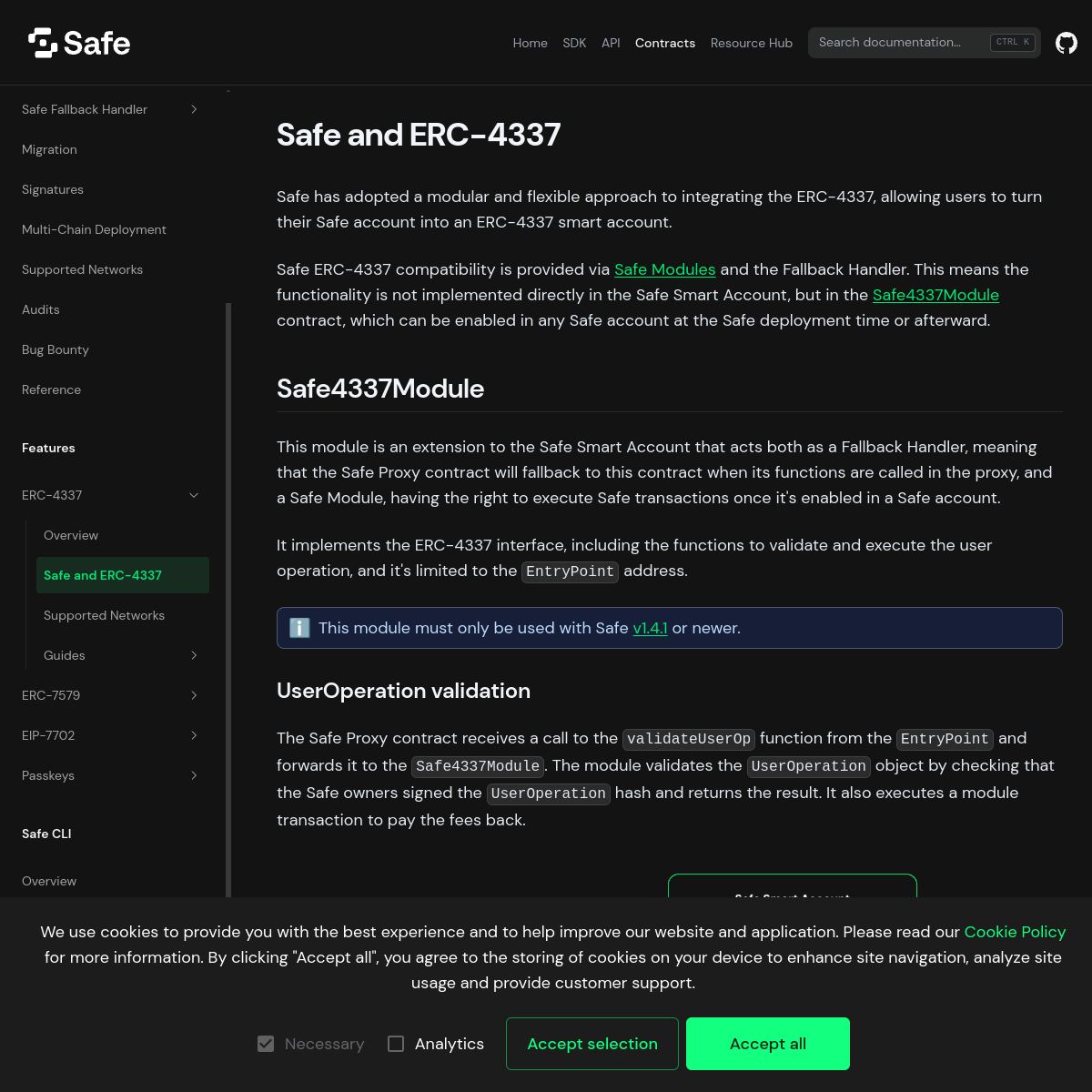
Safe’s ERC-4337 documentation directly frames Safe within the 4337 account-abstraction path, while its broader Smart Account overview explains the underlying model and multisig roots. That combination matters because Safe is not just a wallet frontend. It is a mature smart-account system where owners, thresholds, guards, and modules shape execution.
Why it made the list:
- direct official ERC-4337 documentation
- strong multisig and modular account design
- relevant to both treasury users and advanced individuals
What looks strongest in 2026:
- modularity remains one of Safe’s biggest advantages
- account abstraction is attached to a battle-tested access-control foundation rather than a greenfield wallet concept
- good fit for users who want policy design, not just easier signing
What remains weaker:
- overkill for many beginners
- modules and extensions increase flexibility but also increase review burden
Who it may suit:
- DAOs, teams, and treasury operators
- families or partnerships using shared control
- advanced users who want 4337-style capabilities without giving up structured approvals
2. Argent
Argent still matters in the AA discussion because it treated account abstraction as a user-experience problem years before the term became mainstream search vocabulary.
The Argent docs portal describes Argent as the original smart wallet, says it has been using account abstraction since 2018, and calls ArgentX the first open-source wallet on Starknet powered by native account abstraction. Its Web Wallet documentation also emphasizes no-download, no-seed-phrase onboarding for users who do not already have a crypto wallet.
Why it made the list:
- unusually clear historical position in the AA wallet narrative
- good example of account abstraction being used to lower onboarding friction
- still relevant for Starknet-related wallet comparisons
What looks strongest in 2026:
- strong conceptual link between AA and better onboarding
- good documentation around web-wallet and Starknet wallet flows
- helps readers see that AA is not just an Ethereum 4337 story
What remains weaker:
- the broader product identity is less simple than a one-purpose wallet
- readers looking for a single universal wallet may find the ecosystem split harder to parse
Who it may suit:
- users interested in Starknet wallet UX
- readers comparing seedless onboarding models
- users who want more recovery flexibility than a plain EOA wallet
3. Ambire
Ambire makes this list because it shows one of the most explicit hybrid-AA models on the EVM side.
Its help center overview says the wallet supports EOA, SmarterEOA through EIP-7702, and both Safe and Ambire Smart Accounts. Another Ambire help article says smart wallet is effectively another way of describing account abstraction. Ambire’s support docs also explain that email-and-password accounts can still be self-custodial because they are implemented as 2/2 multisig smart accounts, while warning that this onboarding model is not as strong as a hardware wallet.
Why it made the list:
- one of the clearest official examples of AA being implemented across several account modes
- practical EVM upgrade path instead of a full wallet reset
- unusually specific documentation around trade-offs
What looks strongest in 2026:
- direct support for multiple account models is useful for real users
- EIP-7702 gives Ambire a distinctive angle compared with 4337-only discussions
- the docs are honest that some onboarding flows are convenience-first rather than maximum-security-first
What remains weaker:
- users can get lost if they do not understand which mode they are using
- hybrid systems are powerful, but they demand more explanation than simpler wallets
Who it may suit:
- EVM users who want a gradual path into account abstraction
- users who want batching, gas abstraction, or improved transaction readability
- readers who want an example of AA beyond the standard 4337 talking points
4. Braavos
Braavos belongs on this list because it is one of the clearest examples of native account abstraction being turned into a user-facing security product.
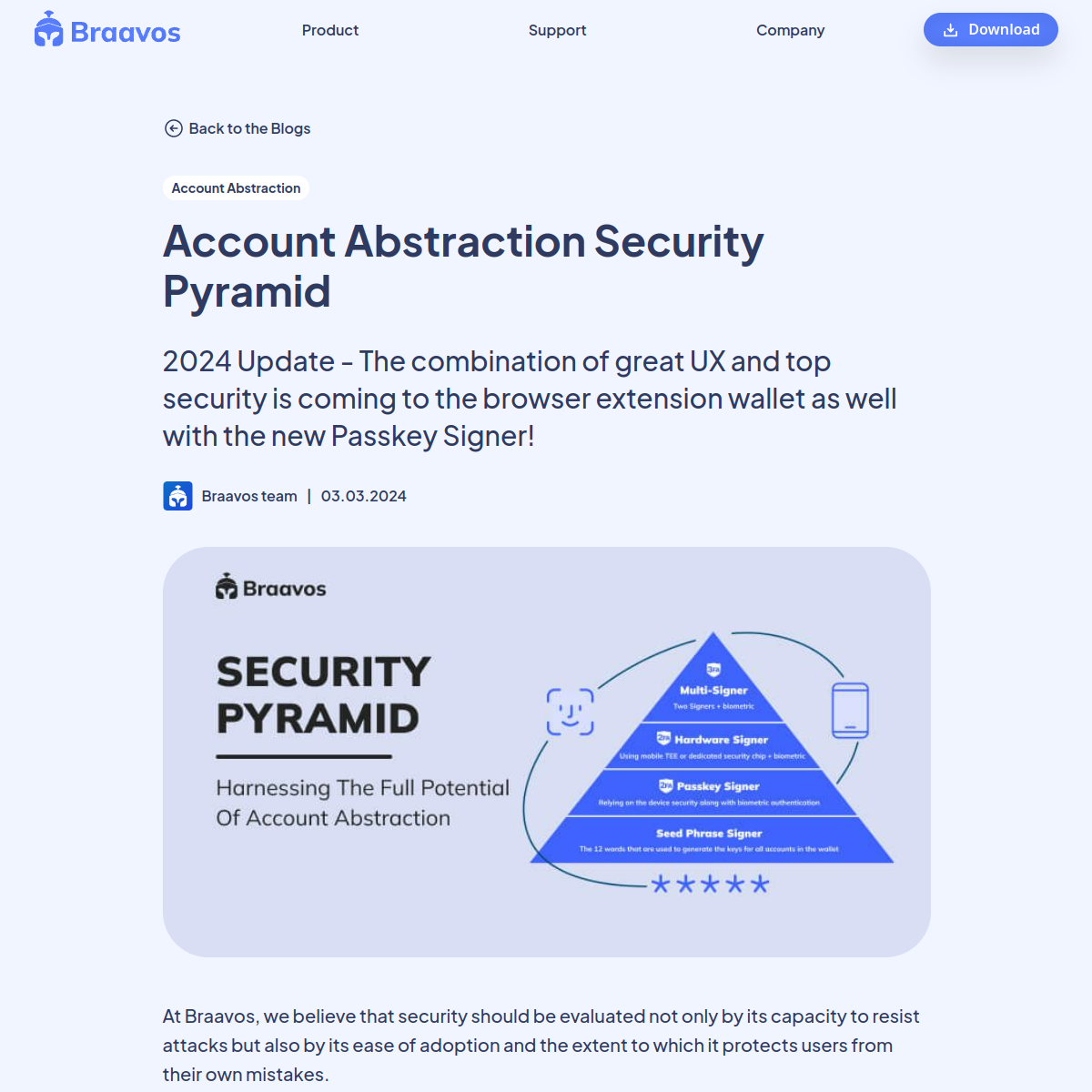
Braavos’ Account Abstraction Security Pyramid says the wallet uses Starknet native account abstraction and cheap computation to improve both UX and security. Its security page and 2FA guide detail passkey signer, hardware signer, and biometric flows, while its multi-owner account page shows how AA can extend into team collaboration and treasury control.
Why it made the list:
- strong native-AA identity on Starknet
- security model is presented in a way users can understand
- combines personal wallet protection and multi-owner collaboration
What looks strongest in 2026:
- Braavos makes AA feel like a concrete security improvement, not just protocol jargon
- passkey and biometric signer options are easier for users to map to real habits
- Starknet-native design helps show what AA looks like when it is built into the stack rather than layered on later
What remains weaker:
- narrower relevance for readers who do not use Starknet
- some stronger signer and recovery setups require more operational discipline
Who it may suit:
- Starknet users
- mobile-first users who care about biometric protection
- teams that want more advanced self-custody collaboration inside Starknet
5. Coinbase Smart Wallet
Coinbase Smart Wallet is the clearest example on this list of AA ideas being packaged for mainstream onboarding.
Coinbase’s Smart Wallet help page says that if a user creates the wallet with a passkey, they are using a smart wallet. Its official launch post framed the product around passkeys, lower-friction onboarding, and a portable wallet experience across apps. That is a different account-abstraction story from Safe or Braavos. It is less about governance structure and more about making self-custody feel familiar.
Why it made the list:
- large mainstream distribution
- passkey-first onboarding makes AA easier to understand for non-technical users
- strong Base adjacency gives it real consumer relevance
What looks strongest in 2026:
- one of the lowest-friction entries into the smart-wallet model
- helps users onboard without starting with extension setup and seed management
- turns account abstraction into a wallet experience, not just a developer feature set
What remains weaker:
- power users may want more explicit policy controls
- Coinbase notes that smart-wallet transactions on Ethereum can cost more because they rely on smart contracts
- some users still prefer a classic seed-phrase wallet model they fully control from the start
Who it may suit:
- newer users
- Base-centered users
- readers who want the most mainstream AA wallet entry point
Which Account Abstraction Wallet Model Fits Which User
If you only want the practical chooser:
- choose Safe if you want multisig structure, modularity, and treasury-grade control
- choose Argent if you want a user-friendly smart-wallet lineage tied closely to Starknet and recovery UX
- choose Ambire if you want hybrid EVM account models, including EIP-7702
- choose Braavos if you want native Starknet AA with strong biometric or hardware-backed security
- choose Coinbase Smart Wallet if you want the simplest passkey-first onboarding flow
That framing matters for SEO as well as user intent. Many readers search one keyword but actually want very different products.
What to Check Before Choosing an AA Wallet
Before moving funds, check:
- whether the wallet uses native AA, ERC-4337, EIP-7702, or some hybrid design
- how recovery works if the device or signer is lost
- whether fees may be higher on some chains because smart-contract execution adds overhead
- whether the wallet supports the chain and dapps you actually use
- whether the wallet is optimized for individuals, teams, or both
- whether convenience-focused onboarding is an acceptable trade-off for your security standard
Readers who are earlier in the wallet-learning curve may also want Coincu’s guides to the best crypto wallets and how to use a crypto wallet before choosing a more specialized AA wallet.
FAQ
Is account abstraction the same as a smart contract wallet?
They overlap heavily, but the exact implementation varies. On Ethereum, people often use account abstraction to refer to smart-account approaches like ERC-4337. On Starknet, account abstraction is native to the chain design. In practice, many user-facing AA wallets are also smart contract wallets.
Is ERC-4337 the only account abstraction approach?
No. ERC-4337 is one major approach on Ethereum-style ecosystems, but newer models like EIP-7702 also matter, and some chains such as Starknet have native account abstraction patterns.
Which AA wallet is best for beginners?
For many mainstream users, Coinbase Smart Wallet is the easiest starting point because passkeys feel familiar. Argent can also make sense for users who want easier onboarding concepts. Safe is usually better once governance, thresholds, or shared control become important.
Which AA wallet is best for teams?
Safe is usually the strongest default starting point for teams because multisig structure and modular control are central to the product. Braavos also becomes interesting for Starknet-native teams because of its multi-owner account model.
Is account abstraction always safer?
Not automatically. It can improve recovery, reduce single-key dependence, and enable better controls, but it also adds smart-contract logic, wallet-specific dependencies, and configuration complexity. The real answer depends on the implementation and on how carefully the user sets it up.
Further Reading
- Top smart contract wallet projects
- What crypto custody is
- Best crypto wallet guide
- How to use a crypto wallet
References
- Safe and ERC-4337
- Safe Smart Account overview
- Argent docs home
- Argent Web Wallet
- Ambire Wallet overview
- Ambire: What does smart wallet mean?
- Ambire: How email/password accounts are self-custodial
- Braavos Account Abstraction Security Pyramid
- Braavos security page
- Braavos biometric 2FA guide
- Braavos multi-owner account
- Coinbase Help: Smart Wallet
- Coinbase blog: Smart Wallet is Here


- China, US Conclude Trade Talks with Focus on Cooperation
- Crypto Weekly: NYSE Backs OKX, Kraken Gets Fed Access, BTC Sells
- Court Upholds Fed’s Rejection of Custodia Bank’s Request
- Former CFO Convicted for $35M Fraudulent Crypto Investment
- DeriW Launches Edge Hour Trading Competition Platform for Derivatives Traders
- Michael Saylor Denies Bitcoin Sell-Off Amid Large BTC Transfer
- Buy Dogecoin on eToro: Step-by-Step Guide for Beginners (2024)
- Kazakhstan Explores Crypto Reserves Backed by National Funds
- JPMorgan Increases Holdings in BlackRock’s Bitcoin ETF
- Nordea Bank Introduces Bitcoin ETP Trading for Nordic Customers
- XRP Spot ETF Launches on Nasdaq Amid Market Fluctuations
- Peter Schiff Challenges Michael Saylor on MSTR’s Business Model
- Thailand Orders Worldcoin to Delete 1.2 Million Biometric Records
- UK Proposes New DeFi Tax Framework to Ease User Burden
- WLFI Under Fire: Analyst Warns Hyperliquid Could Be Next
- Ancient Ethereum Whale Moves $1.19 Billion After Decade
- BlackRock Receives Large Crypto Transfers from Coinbase
- SEC Scrutiny on ALT5 Sigma’s Leadership Disclosure Timing
- Yala Injects $5.5 Million Amid Recovery Efforts
- Radiant Capital Faces $50M Loss in Major Security Breach
- China, US Conclude Trade Talks with Focus on Cooperation
- Crypto Weekly: NYSE Backs OKX, Kraken Gets Fed Access, BTC Sells
- Court Upholds Fed’s Rejection of Custodia Bank’s Request
- Former CFO Convicted for $35M Fraudulent Crypto Investment
- DeriW Launches Edge Hour Trading Competition Platform for Derivatives Traders
- Michael Saylor Denies Bitcoin Sell-Off Amid Large BTC Transfer
- Buy Dogecoin on eToro: Step-by-Step Guide for Beginners (2024)
- Kazakhstan Explores Crypto Reserves Backed by National Funds
- JPMorgan Increases Holdings in BlackRock’s Bitcoin ETF
- Nordea Bank Introduces Bitcoin ETP Trading for Nordic Customers
- XRP Spot ETF Launches on Nasdaq Amid Market Fluctuations
- Peter Schiff Challenges Michael Saylor on MSTR’s Business Model
- Thailand Orders Worldcoin to Delete 1.2 Million Biometric Records
- UK Proposes New DeFi Tax Framework to Ease User Burden
- WLFI Under Fire: Analyst Warns Hyperliquid Could Be Next
- Ancient Ethereum Whale Moves $1.19 Billion After Decade
- BlackRock Receives Large Crypto Transfers from Coinbase
- SEC Scrutiny on ALT5 Sigma’s Leadership Disclosure Timing
- Yala Injects $5.5 Million Amid Recovery Efforts
- Radiant Capital Faces $50M Loss in Major Security Breach
- China, US Conclude Trade Talks with Focus on Cooperation
- Crypto Weekly: NYSE Backs OKX, Kraken Gets Fed Access, BTC Sells
- Court Upholds Fed’s Rejection of Custodia Bank’s Request
- Former CFO Convicted for $35M Fraudulent Crypto Investment
- DeriW Launches Edge Hour Trading Competition Platform for Derivatives Traders
- Michael Saylor Denies Bitcoin Sell-Off Amid Large BTC Transfer
- Buy Dogecoin on eToro: Step-by-Step Guide for Beginners (2024)
- Kazakhstan Explores Crypto Reserves Backed by National Funds
- JPMorgan Increases Holdings in BlackRock’s Bitcoin ETF
- Nordea Bank Introduces Bitcoin ETP Trading for Nordic Customers
- XRP Spot ETF Launches on Nasdaq Amid Market Fluctuations
- Peter Schiff Challenges Michael Saylor on MSTR’s Business Model
- Thailand Orders Worldcoin to Delete 1.2 Million Biometric Records
- UK Proposes New DeFi Tax Framework to Ease User Burden
- WLFI Under Fire: Analyst Warns Hyperliquid Could Be Next
- Ancient Ethereum Whale Moves $1.19 Billion After Decade
- BlackRock Receives Large Crypto Transfers from Coinbase
- SEC Scrutiny on ALT5 Sigma’s Leadership Disclosure Timing
- Yala Injects $5.5 Million Amid Recovery Efforts
- Radiant Capital Faces $50M Loss in Major Security Breach

South Korean Exchange Bithumb Targets 2028 IPO Amid Regulatory Scrutiny


Coldcard Bitcoin Exploit Losses Reach $88 Million Amid Security Fallout
Performa Marks One Year Live with Major Upgrade for Digital-Native SMBs

Zoomex to Attend Coinfest Asia 2026 as Gold Sponsor and Host Summer Bay Party in Bali