Who Was Len Sassaman? Why Some Link Him to Satoshi Nakamoto in 2026
Len Sassaman was a privacy researcher, cypherpunk, cryptographer, and open-source technologist whose work touched many of the ideas that later shaped Bitcoin. He is often discussed as a possible candidate for Satoshi Nakamoto, the pseudonymous creator of Bitcoin, because of his background in anonymous communication, cryptography, remailers, peer-to-peer systems, and digital-cash culture.
As of May 17, 2026, there is still no definitive public proof that Len Sassaman was Satoshi Nakamoto. The strongest version of the theory remains circumstantial: Sassaman had the right technical background, moved in the right cypherpunk circles, worked on privacy tools related to anonymous communication, knew important early Bitcoin figures, and died in 2011 shortly after Satoshi withdrew from public communication.

The theory gained fresh attention in April 2026 after the documentary Finding Satoshi argued that Bitcoin may have been created by two people working under one pseudonym: Hal Finney and Len Sassaman. That claim updated the older “Len was Satoshi” theory into a co-creator hypothesis. But it remains a theory, not a settled historical fact.
| Key Takeaways – Len Sassaman was a respected privacy advocate and cryptographer known for remailers, Mixmaster, OpenPGP-related work, and cypherpunk research. – The Sassaman-Satoshi theory is serious enough to explain, but it remains unproven because no signed message, wallet evidence, code archive, or verified confession has confirmed it. – In 2026, Finding Satoshi revived the debate by arguing that Hal Finney and Len Sassaman may have jointly created Bitcoin under the Satoshi Nakamoto pseudonym. – The most accurate conclusion in 2026 is that Sassaman was part of the world that made Bitcoin possible, but Satoshi Nakamoto’s identity remains unknown.. |
The Len Sassaman and Satoshi Nakamoto Theory
Who Was Len Sassaman?
Leonard Harris Sassaman, commonly known as Len Sassaman, was an American technologist, cryptographer, and information privacy advocate. He was born on April 9, 1980, and became active in hacker and cypherpunk communities at a young age.
Sassaman’s career focused on technologies for privacy, anonymity, and secure communication. He worked with anonymous remailer systems, contributed to OpenPGP-related work, and researched security problems involving certificate infrastructure, privacy-enhancing protocols, and peer-to-peer communication.

He is especially associated with Mixmaster, a type II anonymous remailer system. Remailers were designed to let users send messages without exposing their identity. That may sound far from Bitcoin at first, but both remailers and Bitcoin grew from the same cypherpunk concern: how to create systems that let individuals communicate or transact without relying on centralized trust.
Sassaman also worked in Belgium at COSIC, the Computer Security and Industrial Cryptography research group at KU Leuven. His academic environment connected him to major cryptographic research traditions, including the work of David Chaum, whose ideas around digital cash influenced decades of cypherpunk thought before Bitcoin.
Timeline: Len Sassaman, Bitcoin, and Satoshi
| Date | Event |
|---|---|
| April 9, 1980 | Len Sassaman is born in Pennsylvania. |
| 1990s-2000s | Sassaman becomes active in cryptography, privacy, remailer, and cypherpunk circles. |
| 2004 | Hal Finney publishes Reusable Proofs of Work, an important precursor concept for Bitcoin. |
| October 31, 2008 | Satoshi Nakamoto publishes the Bitcoin whitepaper on the cryptography mailing list. |
| January 3, 2009 | Bitcoin’s genesis block is mined. |
| January 12, 2009 | Satoshi sends 10 BTC to Hal Finney in the first known Bitcoin transaction between users. |
| 2010 | Satoshi’s public involvement in Bitcoin begins to fade. |
| April 2011 | Satoshi sends final known private communications saying he has moved on to other things. |
| July 3, 2011 | Len Sassaman dies at age 31. Public memorials identify suicide after depression. |
| February 2021 | Evan Hatch publishes a detailed essay linking Sassaman to the Satoshi theory. |
| October 2024 | HBO’s Money Electric names Peter Todd as Satoshi; Todd denies it. |
| April 2026 | Finding Satoshi argues that Hal Finney and Len Sassaman may have been Bitcoin’s co-creators. |
| May 2026 | No definitive public proof has established Satoshi Nakamoto’s identity. |
What Is the Len Sassaman and Satoshi Nakamoto Theory?
The Len Sassaman theory argues that Sassaman may have been involved in the creation of Bitcoin, either as Satoshi Nakamoto or as part of a small group using the Satoshi pseudonym.
The theory does not rely on a single smoking gun. Instead, it combines several pieces of circumstantial evidence: Sassaman worked on privacy systems before Bitcoin, he was part of the cypherpunk world, he had experience with remailers, he knew people who influenced early Bitcoin, and Satoshi’s final known communications came in 2011, the same year Sassaman died.
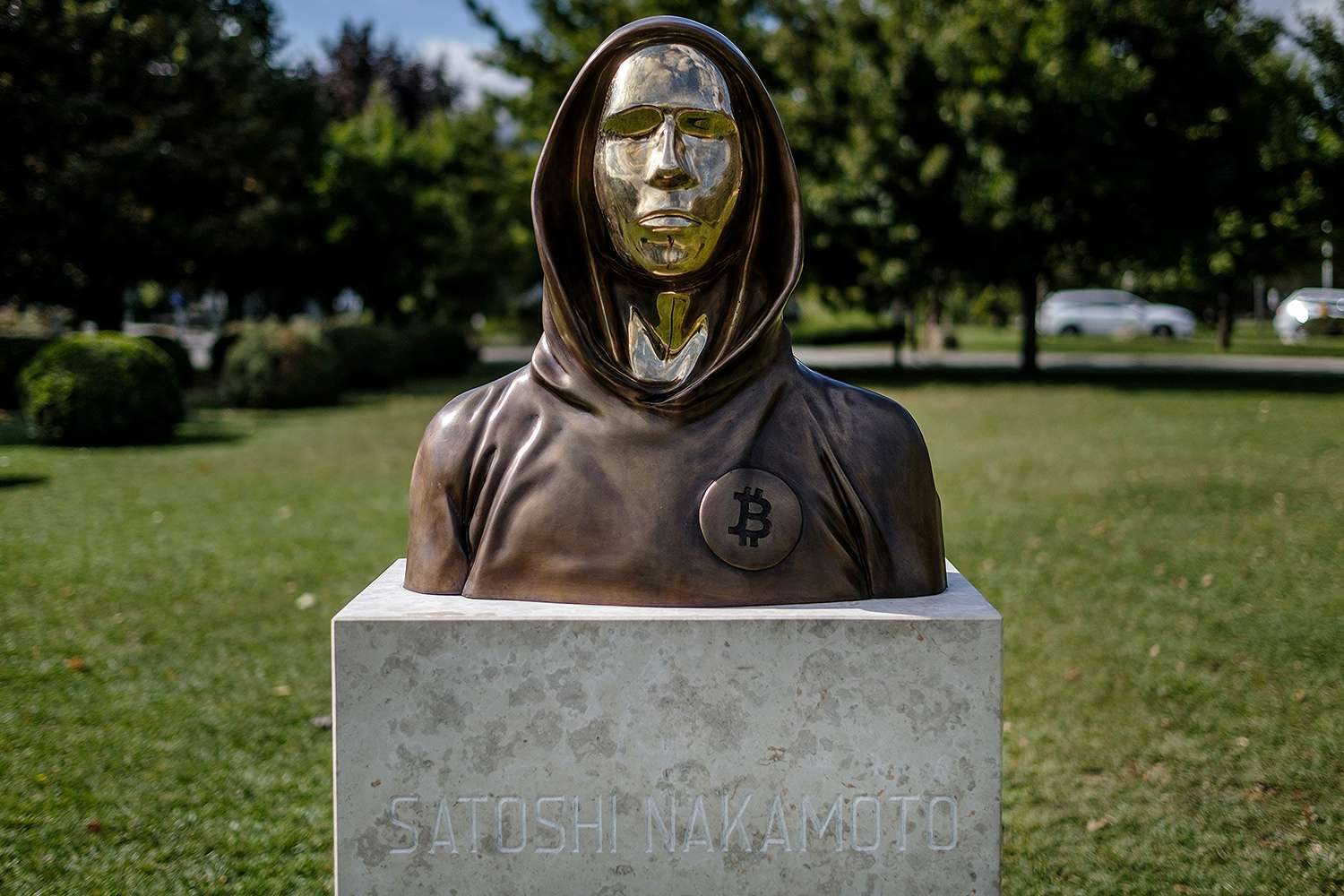
The theory became more visible after Evan Hatch’s 2021 essay. Hatch argued that Sassaman had the rare mix of skills needed to build Bitcoin: public-key cryptography, privacy engineering, remailer systems, peer-to-peer protocols, and cypherpunk ideology.
Coincu has also covered related Satoshi identity speculation, including the 2024 report that Satoshi Nakamoto’s identity could be revealed in an HBO documentary.
Read more: Satoshi Nakamoto, One Of The Most Mysterious Characters Of The 21st Century
Why Some Believe Len Sassaman Could Be Satoshi
1. He Had the Right Cypherpunk Background
Bitcoin did not appear out of nowhere. It was built on decades of work in digital cash, cryptography, proof-of-work, timestamping, peer-to-peer networking, and privacy technology.

Sassaman belonged to the cypherpunk culture that treated cryptography as a tool for individual freedom. That culture produced many ideas directly relevant to Bitcoin, including pseudonymous communication, censorship-resistant publishing, anonymous markets, digital cash, and systems that reduce the need for trusted intermediaries.
Even if Sassaman was not Satoshi, his work sat close to the intellectual roots of Bitcoin.
2. His Work on Remailers Is Technically Relevant
Anonymous remailers helped users send messages without revealing their identity. Mixmaster used cryptographic techniques and distributed routing to make message tracing harder.
Bitcoin is not a remailer, but both systems address a similar design problem: how to coordinate activity across a network without relying on a central authority or exposing unnecessary identity information.
This is why remailer developers often appear in Satoshi discussions. Hal Finney, Adam Back, and Len Sassaman all had connections to the remailer or anti-spam proof-of-work worlds that fed into Bitcoin’s design history.
3. He Had Connections to Hal Finney
Hal Finney is one of the strongest Satoshi candidates and one of the most important early Bitcoin figures. He received the first Bitcoin transaction from Satoshi, tested the early software, and had already developed Reusable Proofs of Work before Bitcoin.

The Sassaman theory becomes more plausible to some researchers because Sassaman and Finney were part of overlapping cryptography and PGP circles. The 2026 documentary leaned into this connection by proposing a joint Finney-Sassaman authorship theory.
The counterpoint is important: Finney publicly interacted with Satoshi, received Bitcoin from Satoshi, and continued to be visible after Satoshi disappeared. For Finney to be Satoshi, or part of Satoshi, he would have needed to maintain a deliberate separation between his public identity and the Satoshi persona.
4. He Worked Near Digital-Cash Research Traditions
At COSIC in Belgium, Sassaman worked in an academic environment connected to major cryptographic research. David Chaum, often described as a foundational figure in digital cash, influenced the field long before Bitcoin.
This does not prove Sassaman created Bitcoin. But it does place him in a community where the technical and philosophical problems behind Bitcoin were actively understood.
5. The Timeline Is Suspicious to Some Researchers
Satoshi’s known public activity declined sharply by late 2010, and his final known private emails came in April 2011. Sassaman died on July 3, 2011, and the news quickly spread through cryptography and technology communities.
Supporters of the theory see this timing as meaningful. They argue that Sassaman’s death could explain why Satoshi never returned, never moved the coins widely attributed to early Satoshi mining, and never claimed credit.
But timing alone is weak evidence. Many people disappear from public projects for ordinary reasons. Satoshi may have intentionally left Bitcoin to decentralize its leadership. Satoshi may have been someone else entirely. The timeline is notable, but it is not proof.
Read more: Satoshi Nakamoto Identity To Be Revealed In New HBO Documentary on Oct 8
Evidence For and Against the Sassaman Theory
| Claim | Why it supports the theory | Why it is not conclusive |
|---|---|---|
| Sassaman worked on Mixmaster and remailers | Shows deep expertise in anonymity systems and cypherpunk infrastructure | Bitcoin is not a remailer, and many cypherpunks had related expertise |
| Sassaman knew people in early crypto circles | Places him near Finney, Back, PGP, and digital-cash discussions | Proximity is not authorship |
| Satoshi disappeared in 2011, the year Sassaman died | Explains why Satoshi never returned publicly | Correlation does not prove identity |
| European time-zone theories may fit Sassaman’s Belgium years | Some analysts argue Satoshi’s activity patterns may fit Europe | Activity windows can be manipulated |
| Sassaman had technical breadth | He understood cryptography, privacy tools, and distributed systems | Bitcoin required specific code and economic design evidence that has not been directly tied to him |
| Finding Satoshi named Finney and Sassaman as possible co-creators | Brings a collaboration theory into public debate | Documentary claims are still circumstantial without cryptographic or archival proof |
Reasons to Doubt Len Sassaman Was Satoshi
The biggest weakness in the Len Sassaman theory is the lack of direct evidence. No signed message from a Satoshi-linked key, verified private archive, original Bitcoin code record, wallet movement, or authenticated confession has publicly tied Sassaman to Bitcoin‘s creation.

Many clues often cited by supporters, such as British spelling, time-zone analysis, privacy expertise, and cypherpunk connections, are circumstantial. Satoshi Nakamoto may also have intentionally obscured personal details, which makes language and activity-pattern analysis unreliable.
There is also a behavioral gap. Sassaman was a visible figure in cryptography and hacker communities, while Satoshi avoided personal exposure and disappeared after Bitcoin had enough independent contributors. Supporters argue Sassaman could have compartmentalized the Satoshi identity, but skeptics see this as a serious mismatch.

Finally, no close associate has produced direct proof that Sassaman was Satoshi, and several other candidates, including Hal Finney, Nick Szabo, Adam Back, Peter Todd, and David Chaum, remain part of the debate. The responsible conclusion is that Sassaman is a plausible historical candidate, not a proven one.
2026 Candidate Comparison
| Candidate | Why people discuss them | 2026 status |
|---|---|---|
| Len Sassaman | Remailers, cypherpunk background, privacy research, Europe/COSIC connections, 2011 timing | Serious but unproven candidate; revived by Finding Satoshi |
| Hal Finney | First Bitcoin transaction recipient, early contributor, reusable proof-of-work, direct Satoshi correspondence | Central candidate; 2026 documentary claims possible co-creator role |
| Nick Szabo | Bit Gold, smart contracts, digital-cash theory, writing-style comparisons | Long-running candidate; no proof |
| Adam Back | Hashcash creator, early cypherpunk, direct relevance to Bitcoin mining design | Renewed 2026 attention; Back denies being Satoshi |
| Peter Todd | Named by HBO’s 2024 documentary | Todd denies claim; widely treated as unproven |
| David Chaum | Foundational digital-cash pioneer | Major intellectual influence, but not a proven Satoshi candidate |
Read more: SEC Seeks To Take Satoshi Nakamoto To Court With Lawsuit Against Bitcoin
Was Len Sassaman Satoshi Nakamoto?
The best answer in 2026 is: possibly, but not proven. Len Sassaman had the technical background, ideological environment, and social proximity to make the theory worth discussing.
He worked on privacy systems that solved problems adjacent to Bitcoin. He was connected to the cypherpunk movement. His life overlapped with people and ideas that shaped Bitcoin’s creation.
But the evidence remains circumstantial. The Sassaman theory does not yet have the kind of proof that would settle the Satoshi question. A signed message from Satoshi’s keys, authenticated source-code records, private correspondence with verifiable metadata, or credible testimony supported by primary documents would be needed to move the theory from plausible to proven.
For now, Sassaman should be remembered first as an important privacy technologist and cypherpunk. Whether or not he was Satoshi, his work belongs in the history that made Bitcoin possible.
Why the Satoshi Mystery Still Matters
Satoshi’s identity matters for cultural, historical, legal, and market reasons. Historically, knowing who created Bitcoin would clarify how one of the most important financial technologies of the 21st century emerged.
Culturally, Satoshi has become a symbol of decentralization and voluntary disappearance from power. Economically, wallets widely believed to be linked to early Satoshi mining still hold a large amount of unmoved Bitcoin, so any credible sign of Satoshi’s return could affect market sentiment.
At the same time, there are ethical risks. Publicly naming people as Satoshi can bring unwanted attention, harassment, legal pressure, and reputational harm. This is especially sensitive when the people being discussed are deceased or cannot respond.
That is why the Sassaman theory should be presented as a historical investigation, not as a declaration. Coincu’s Len Sassaman topic page can also be used to group future updates if more evidence appears.
Read more: Was The CIA Behind Bitcoin Creator Satoshi Nakamoto’s ‘Disappearance’?
Conclusion
Len Sassaman remains one of the more credible names in the Satoshi Nakamoto debate because his technical life sat close to Bitcoin’s origins: cryptography, remailers, privacy, cypherpunk culture, and early digital-cash thinking. The 2026 Finding Satoshi documentary made the theory more visible by presenting a possible Hal Finney and Len Sassaman collaboration.
Still, the public evidence does not prove that Sassaman was Satoshi. The responsible conclusion is narrower: Sassaman was an important privacy technologist whose work belongs in the history behind Bitcoin, while Satoshi Nakamoto’s identity remains unknown in 2026.
FAQs
Is there definitive proof that Len Sassaman was Satoshi Nakamoto?
No. As of May 17, 2026, there is no definitive public proof that Len Sassaman was Satoshi Nakamoto. The theory is based on circumstantial evidence involving his technical background, cypherpunk connections, remailer work, and timeline.
What did the 2026 Finding Satoshi documentary claim?
The documentary argued that Bitcoin may have been created by two people working under the Satoshi Nakamoto pseudonym: Hal Finney and Len Sassaman. This renewed interest in Sassaman but did not settle the question.
What was Len Sassaman known for?
Sassaman was known for privacy advocacy, anonymous remailer technology, Mixmaster, OpenPGP-related work, security research, and his role in the cypherpunk community.
Is Satoshi Nakamoto’s identity known in 2026?
No. Despite documentaries, books, investigations, and recurring public speculation, Satoshi Nakamoto’s identity remains unknown as of May 2026.
Methodology
This article was updated on May 17, 2026 by comparing the previous Coincu article with primary and high-quality secondary sources. For the historical claims, this update prioritized sources close to the record: the Bitcoin whitepaper archive, the Chaos Computer Club memorial for Len Sassaman, Evan Hatch’s 2021 essay “Len Sassaman and Satoshi: a Cypherpunk History”, and contemporary reporting on the 2026 documentary
| DISCLAIMER: The information on this website is provided as general market commentary and does not constitute investment advice. We encourage you to do your own research before investing. |


Other Posts







- Amplify 2024: Ohio’s Premier Blockchain Summit
- China, US Conclude Trade Talks with Focus on Cooperation
- Crypto Weekly: NYSE Backs OKX, Kraken Gets Fed Access, BTC Sells
- DeriW Launches Edge Hour Trading Competition Platform for Derivatives Traders
- Michael Saylor Denies Bitcoin Sell-Off Amid Large BTC Transfer
- Court Upholds Fed’s Rejection of Custodia Bank’s Request
- Former CFO Convicted for $35M Fraudulent Crypto Investment
- EU Opens Antitrust Probe Into Deutsche Boerse and Nasdaq Derivatives Dealings
- Kazakhstan Explores Crypto Reserves Backed by National Funds
- JPMorgan Increases Holdings in BlackRock’s Bitcoin ETF
- Nordea Bank Introduces Bitcoin ETP Trading for Nordic Customers
- XRP Spot ETF Launches on Nasdaq Amid Market Fluctuations
- JPMorgan Chase Launches 24/7 Digital Deposit Token for Clients
- Crypto Leaders Address Macro Volatility Amid Market Shifts
- Buy Dogecoin on eToro: Step-by-Step Guide for Beginners (2024)
- Peter Schiff Challenges Michael Saylor on MSTR’s Business Model
- Thailand Orders Worldcoin to Delete 1.2 Million Biometric Records
- UK Proposes New DeFi Tax Framework to Ease User Burden
- U.S. Treasury Proposes New Tax Relief Regulations
- Uniswap’s UNIfication Proposal Gains Massive Preliminary Support
- Amplify 2024: Ohio’s Premier Blockchain Summit
- China, US Conclude Trade Talks with Focus on Cooperation
- Crypto Weekly: NYSE Backs OKX, Kraken Gets Fed Access, BTC Sells
- DeriW Launches Edge Hour Trading Competition Platform for Derivatives Traders
- Michael Saylor Denies Bitcoin Sell-Off Amid Large BTC Transfer
- Court Upholds Fed’s Rejection of Custodia Bank’s Request
- Former CFO Convicted for $35M Fraudulent Crypto Investment
- EU Opens Antitrust Probe Into Deutsche Boerse and Nasdaq Derivatives Dealings
- Kazakhstan Explores Crypto Reserves Backed by National Funds
- JPMorgan Increases Holdings in BlackRock’s Bitcoin ETF
- Nordea Bank Introduces Bitcoin ETP Trading for Nordic Customers
- XRP Spot ETF Launches on Nasdaq Amid Market Fluctuations
- JPMorgan Chase Launches 24/7 Digital Deposit Token for Clients
- Crypto Leaders Address Macro Volatility Amid Market Shifts
- Buy Dogecoin on eToro: Step-by-Step Guide for Beginners (2024)
- Peter Schiff Challenges Michael Saylor on MSTR’s Business Model
- Thailand Orders Worldcoin to Delete 1.2 Million Biometric Records
- UK Proposes New DeFi Tax Framework to Ease User Burden
- U.S. Treasury Proposes New Tax Relief Regulations
- Uniswap’s UNIfication Proposal Gains Massive Preliminary Support
- Amplify 2024: Ohio’s Premier Blockchain Summit
- China, US Conclude Trade Talks with Focus on Cooperation
- Crypto Weekly: NYSE Backs OKX, Kraken Gets Fed Access, BTC Sells
- DeriW Launches Edge Hour Trading Competition Platform for Derivatives Traders
- Michael Saylor Denies Bitcoin Sell-Off Amid Large BTC Transfer
- Court Upholds Fed’s Rejection of Custodia Bank’s Request
- Former CFO Convicted for $35M Fraudulent Crypto Investment
- EU Opens Antitrust Probe Into Deutsche Boerse and Nasdaq Derivatives Dealings
- Kazakhstan Explores Crypto Reserves Backed by National Funds
- JPMorgan Increases Holdings in BlackRock’s Bitcoin ETF
- Nordea Bank Introduces Bitcoin ETP Trading for Nordic Customers
- XRP Spot ETF Launches on Nasdaq Amid Market Fluctuations
- JPMorgan Chase Launches 24/7 Digital Deposit Token for Clients
- Crypto Leaders Address Macro Volatility Amid Market Shifts
- Buy Dogecoin on eToro: Step-by-Step Guide for Beginners (2024)
- Peter Schiff Challenges Michael Saylor on MSTR’s Business Model
- Thailand Orders Worldcoin to Delete 1.2 Million Biometric Records
- UK Proposes New DeFi Tax Framework to Ease User Burden
- U.S. Treasury Proposes New Tax Relief Regulations
- Uniswap’s UNIfication Proposal Gains Massive Preliminary Support
Latest

Binance Life Wallet Sends 3.5M Tokens to Binance After $12.38M Run

Tiger Research: Korean Crypto Retail Participation Declines Ahead of 2026

Press Release
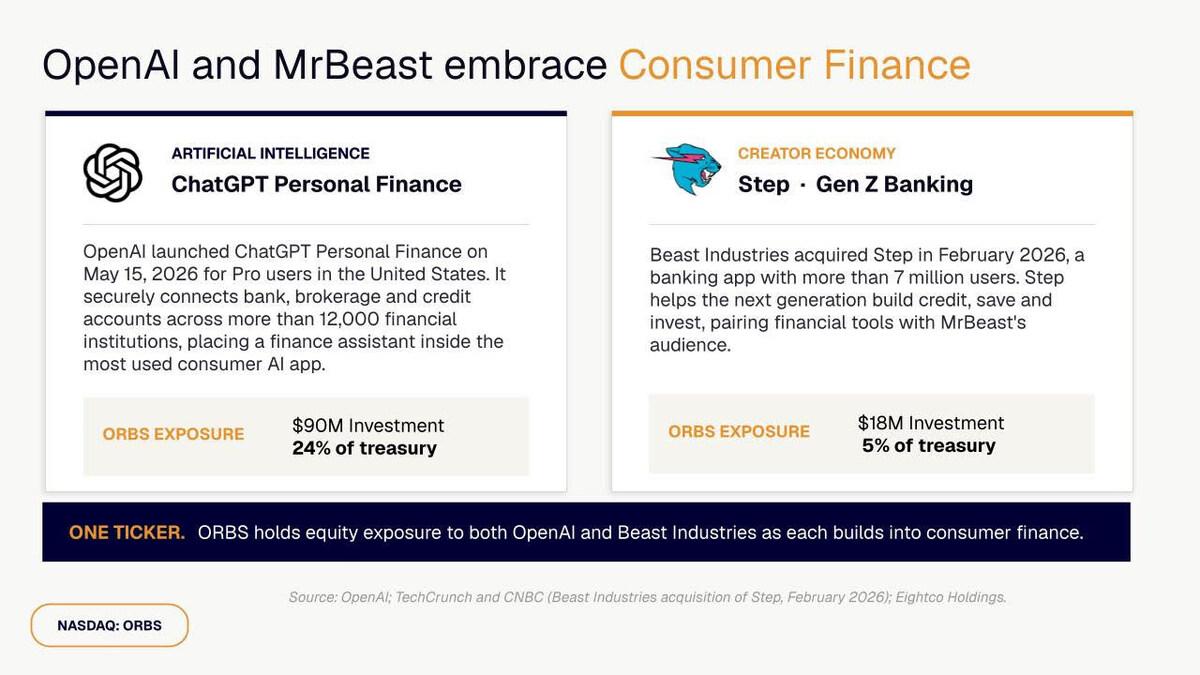
Eightco (NASDAQ: ORBS) Reports $374M Holdings Across OpenAI, WLD, ETH and Strategic Investments