Treasury Secretary Backs Summer CLARITY Act Push, Bitcoin Reserve Advances
U.S. Treasury Secretary Scott Bessent has voiced support for advancing the CLARITY Act through Congress this summer while describing the federal government’s Bitcoin reserve initiative as moving forward at a deliberate pace, signaling a structured approach to digital asset policy on two fronts.
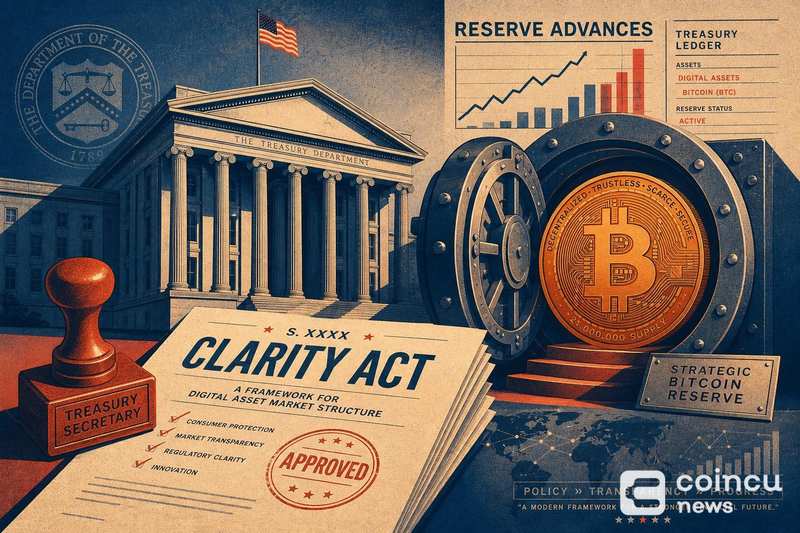
Bessent’s remarks, delivered during a Senate Finance Committee hearing on the President’s fiscal year 2027 budget, addressed both legislative and executive-branch efforts shaping the future of crypto regulation in the United States.
Bessent Endorses a Summer Timeline for the CLARITY Act
The CLARITY Act is a proposed bill aimed at establishing clearer regulatory definitions for digital assets, particularly around which tokens qualify as securities versus commodities. The legislation has been a focal point for industry participants seeking predictable compliance frameworks.
During his testimony before the Senate Finance Committee, Bessent indicated the administration backs pushing the bill forward over the summer months. The endorsement from the Treasury Secretary adds executive-branch weight to what had been primarily a congressional effort.
A summer push would place the CLARITY Act alongside other pending crypto legislation, including stablecoin bills that have attracted bipartisan attention. The timeline suggests the administration views the current congressional session as a window for meaningful regulatory progress.
Bitcoin Reserve Effort Described as Advancing at “Deliberate Speed”
Bessent also addressed the federal Bitcoin reserve initiative, characterizing it as advancing prudently rather than on an accelerated timeline. According to reporting from The Block, the Treasury Secretary used language emphasizing measured, careful execution.
The phrase “deliberate speed” signals that while the reserve effort remains active, the administration is prioritizing risk management and institutional process over rapid deployment. For a program involving a volatile asset like Bitcoin, this framing suggests internal review mechanisms and phased implementation.
What “Prudent Advancement” Signals
In treasury and fiscal policy contexts, “prudent” typically indicates adherence to fiduciary standards, cost-benefit analysis, and interagency coordination. Applied to a Bitcoin reserve, it implies the government is not rushing to acquire or hold significant quantities without established custody, accounting, and oversight protocols.
This measured posture contrasts with more aggressive proposals that have circulated in policy circles, where some advocates have pushed for rapid, large-scale Bitcoin accumulation. Bessent’s language suggests the administration is taking a middle path.
How the Two Policy Signals Connect
The pairing of legislative support for the CLARITY Act with cautious reserve advancement reflects a broader strategy: build the regulatory framework first, then expand government engagement with digital assets under that framework.
Regulatory clarity and reserve prudence both point toward structured, incremental crypto engagement rather than ad hoc policy. If the CLARITY Act advances, it could provide the legal definitions needed to govern how federal entities, including the Treasury, interact with digital assets.
Legislative Progress Versus Executive Action
The two tracks operate on different timelines and through different mechanisms. The CLARITY Act requires congressional passage, committee votes, and floor debate. The Bitcoin reserve effort, by contrast, falls more squarely within executive authority and agency discretion.
Bessent’s decision to address both in the same hearing suggests the administration sees them as complementary. A clearer legal environment could reduce the political and legal risks associated with holding Bitcoin on the federal balance sheet, as developments in Bitcoin-linked financial products continue to expand across the market.
Implications for Bitcoin Markets and Industry Participants
For crypto firms operating in the United States, Bessent’s remarks offer a directional signal without concrete commitments. A summer legislative push creates a near-term catalyst for companies monitoring compliance and market structure rules.
The reserve framing, while less immediate, carries longer-term significance. A U.S. government holding Bitcoin, even in modest quantities, would represent a policy endorsement that could influence institutional sentiment. The cautious approach may reassure market participants concerned about destabilizing government purchases.
Bitcoin’s trajectory in recent months has intersected with growing institutional infrastructure, from record trading volumes on prediction markets to expanding derivatives products. Policy clarity from the Treasury adds another variable to the positioning calculus for traders and allocators.
Meanwhile, the broader crypto ecosystem continues to see both institutional momentum and enforcement attention, as illustrated by cases like the recent high-profile Bitcoin theft prosecution that underscored the sector’s evolving security and legal landscape.
FAQ About the CLARITY Act and the Bitcoin Reserve Effort
What is the CLARITY Act?
The CLARITY Act is proposed U.S. legislation designed to establish clear regulatory classifications for digital assets. It aims to define which tokens fall under securities law and which are treated as commodities, providing a consistent framework for the CLARITY Act Bitcoin reserve discussion and broader industry compliance.
Why is the summer timeline important?
A summer push indicates the administration wants to capitalize on the current congressional session before midterm election dynamics potentially slow legislative momentum. It also aligns with parallel stablecoin legislation efforts, creating a concentrated window for crypto policy progress.
What does a prudent Bitcoin reserve approach mean?
It means the federal government is proceeding with institutional safeguards, including custody arrangements, accounting standards, and interagency review, rather than making rapid or large-scale Bitcoin acquisitions. The approach prioritizes risk management over speed.
Disclaimer: This article is for informational purposes only and does not constitute financial or investment advice. Cryptocurrency and digital asset markets carry significant risk. Always do your own research before making decisions.
No tags available.


Other Posts








- Amplify 2024: Ohio’s Premier Blockchain Summit
- China, US Conclude Trade Talks with Focus on Cooperation
- Crypto Weekly: NYSE Backs OKX, Kraken Gets Fed Access, BTC Sells
- DeriW Launches Edge Hour Trading Competition Platform for Derivatives Traders
- Michael Saylor Denies Bitcoin Sell-Off Amid Large BTC Transfer
- Court Upholds Fed’s Rejection of Custodia Bank’s Request
- Former CFO Convicted for $35M Fraudulent Crypto Investment
- EU Opens Antitrust Probe Into Deutsche Boerse and Nasdaq Derivatives Dealings
- Kazakhstan Explores Crypto Reserves Backed by National Funds
- JPMorgan Increases Holdings in BlackRock’s Bitcoin ETF
- Nordea Bank Introduces Bitcoin ETP Trading for Nordic Customers
- XRP Spot ETF Launches on Nasdaq Amid Market Fluctuations
- JPMorgan Chase Launches 24/7 Digital Deposit Token for Clients
- Crypto Leaders Address Macro Volatility Amid Market Shifts
- Buy Dogecoin on eToro: Step-by-Step Guide for Beginners (2024)
- Peter Schiff Challenges Michael Saylor on MSTR’s Business Model
- Thailand Orders Worldcoin to Delete 1.2 Million Biometric Records
- UK Proposes New DeFi Tax Framework to Ease User Burden
- U.S. Treasury Proposes New Tax Relief Regulations
- Uniswap’s UNIfication Proposal Gains Massive Preliminary Support
- Amplify 2024: Ohio’s Premier Blockchain Summit
- China, US Conclude Trade Talks with Focus on Cooperation
- Crypto Weekly: NYSE Backs OKX, Kraken Gets Fed Access, BTC Sells
- DeriW Launches Edge Hour Trading Competition Platform for Derivatives Traders
- Michael Saylor Denies Bitcoin Sell-Off Amid Large BTC Transfer
- Court Upholds Fed’s Rejection of Custodia Bank’s Request
- Former CFO Convicted for $35M Fraudulent Crypto Investment
- EU Opens Antitrust Probe Into Deutsche Boerse and Nasdaq Derivatives Dealings
- Kazakhstan Explores Crypto Reserves Backed by National Funds
- JPMorgan Increases Holdings in BlackRock’s Bitcoin ETF
- Nordea Bank Introduces Bitcoin ETP Trading for Nordic Customers
- XRP Spot ETF Launches on Nasdaq Amid Market Fluctuations
- JPMorgan Chase Launches 24/7 Digital Deposit Token for Clients
- Crypto Leaders Address Macro Volatility Amid Market Shifts
- Buy Dogecoin on eToro: Step-by-Step Guide for Beginners (2024)
- Peter Schiff Challenges Michael Saylor on MSTR’s Business Model
- Thailand Orders Worldcoin to Delete 1.2 Million Biometric Records
- UK Proposes New DeFi Tax Framework to Ease User Burden
- U.S. Treasury Proposes New Tax Relief Regulations
- Uniswap’s UNIfication Proposal Gains Massive Preliminary Support
- Amplify 2024: Ohio’s Premier Blockchain Summit
- China, US Conclude Trade Talks with Focus on Cooperation
- Crypto Weekly: NYSE Backs OKX, Kraken Gets Fed Access, BTC Sells
- DeriW Launches Edge Hour Trading Competition Platform for Derivatives Traders
- Michael Saylor Denies Bitcoin Sell-Off Amid Large BTC Transfer
- Court Upholds Fed’s Rejection of Custodia Bank’s Request
- Former CFO Convicted for $35M Fraudulent Crypto Investment
- EU Opens Antitrust Probe Into Deutsche Boerse and Nasdaq Derivatives Dealings
- Kazakhstan Explores Crypto Reserves Backed by National Funds
- JPMorgan Increases Holdings in BlackRock’s Bitcoin ETF
- Nordea Bank Introduces Bitcoin ETP Trading for Nordic Customers
- XRP Spot ETF Launches on Nasdaq Amid Market Fluctuations
- JPMorgan Chase Launches 24/7 Digital Deposit Token for Clients
- Crypto Leaders Address Macro Volatility Amid Market Shifts
- Buy Dogecoin on eToro: Step-by-Step Guide for Beginners (2024)
- Peter Schiff Challenges Michael Saylor on MSTR’s Business Model
- Thailand Orders Worldcoin to Delete 1.2 Million Biometric Records
- UK Proposes New DeFi Tax Framework to Ease User Burden
- U.S. Treasury Proposes New Tax Relief Regulations
- Uniswap’s UNIfication Proposal Gains Massive Preliminary Support
Latest

Treasury Secretary Backs Summer CLARITY Act Push, Bitcoin Reserve Advances

Kalshi Launches Bitcoin Perpetual Contracts: What It Means for Crypto Markets

Suspected Mastermind in $245M Bitcoin Theft Admits Kidnapping Plot
Press Release

Want to Use AI Trading Without Coding? Why I Think Platforms Like BulkQuant Are Better for Beginners