Sui Mainnet Upgrade Adds Zero-Gas Transaction Simulation, Stability Improvements
Mysten Labs released Sui mainnet-v1.74.1 on July 1, 2026, introducing zero-gas transaction simulation for gasless-tier-eligible flows and two node-level stability fixes targeting unreachable peers and shutdown panics. The upgrade, tagged as protocol version 128, continues a hardening cycle that began after three mainnet outages in late May.
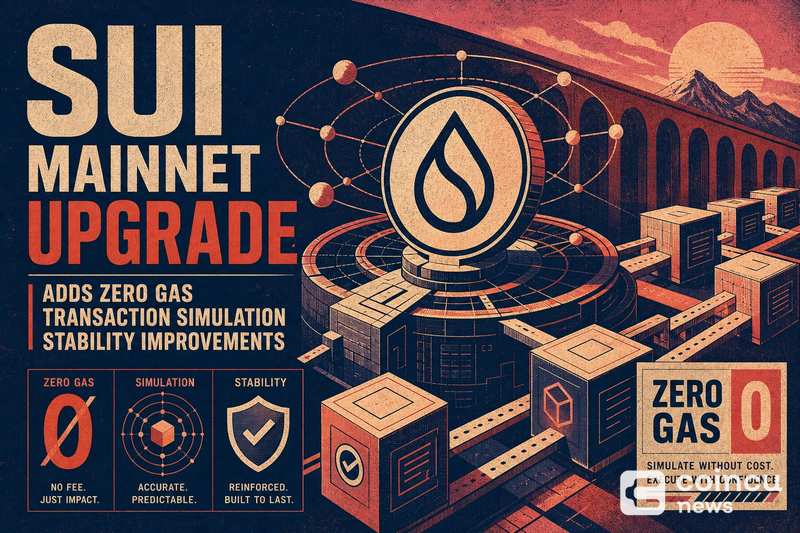
The release modifies gRPC SimulateTransaction to accept gas_price=0 for transactions eligible under Sui’s gasless tier, rather than returning an error. Previously, wallets and dApps attempting to simulate gasless transactions had to supply a non-zero gas price, creating friction in testing workflows for stablecoin transfers and other qualifying operations. For related coverage, see OKX to Launch SOFTBANK, TQQQ, MVLL and MUU Stock Perpetual Contracts.
Sui’s gasless stablecoin transfer feature, introduced on mainnet with v1.72.2, allows qualified peer-to-peer stablecoin payments without SUI gas fees, with a minimum transfer threshold of 0.01. The v1.74.1 change ensures that the simulation layer now matches the execution layer’s handling of these zero-gas flows. For related coverage, see U.S. OFAC Sanctions 134 New Crypto Wallet Addresses.
What Zero-Gas Simulation Changes for Wallets and dApps
Transaction simulation lets wallets and dApps preview the outcome of a transaction before broadcasting it to the network. A user transferring stablecoins, for example, can see whether the transaction would succeed or fail, what state changes it would produce, and what gas it would consume, all without committing anything on-chain.
Before this update, Sui’s gRPC simulation endpoint rejected any request with gas_price=0, even if the underlying transaction qualified for gasless execution. That meant wallet developers building around gasless stablecoin transfers had to either skip simulation entirely or work around the limitation by supplying a dummy gas price, neither of which produced accurate results.
With mainnet-v1.74.1, the simulation endpoint now mirrors production behavior for gasless-eligible transactions. This reduces the gap between what a wallet can preview and what the network will actually execute, directly lowering the risk of failed transactions reaching the chain.
The practical impact is most visible for end users who rely on wallet interfaces to confirm transaction details before signing. A wallet that can accurately simulate a gasless transfer gives users confidence that their stablecoin payment will go through as expected, without requiring them to hold or spend SUI for gas.
Node Stability Fixes Address Post-Outage Hardening
The same release includes two infrastructure-level fixes. The first disconnects consistently unreachable state-sync peers, preventing nodes from wasting resources on connections that repeatedly fail. The second resolves a spurious panic that could occur during normal node shutdown or restart.
Neither fix addresses a vulnerability or data-loss scenario. Instead, they target operational annoyances that degrade node performance over time: zombie peer connections that consume bandwidth and log noise, and false-alarm panics that can trigger unnecessary alerting or complicate validator restarts during maintenance windows.
These changes carry additional weight given Sui’s recent stability history. On May 28-29, 2026, the network experienced three mainnet halts traced to bugs introduced in the v1.72 upgrade. The Sui Foundation’s incident review confirmed that no user funds were at risk or reverted when the network resumed, but the outages highlighted the need for more conservative rollout practices and deeper node-level resilience, similar to challenges other Layer 1 and Layer 2 networks have faced during upgrade cycles.
The Block independently confirmed that Sui’s postmortem traced the three halts to two distinct bugs in the v1.72 release, including one fix that the team had identified as carrying halt risk before deployment. That external reporting underscores why the stability fixes in v1.74.1 matter: they represent continued work to reduce the surface area for similar incidents.
Why Stability Upgrades Matter for Validators and Ecosystem Participants
Mainnet reliability directly affects every participant in the Sui ecosystem. Validators need predictable node behavior to maintain uptime and avoid slashing-adjacent risks. Exchanges depend on consistent block production to process deposits and withdrawals. dApp developers need stable infrastructure to build products that users can trust.
The peer-disconnect fix is particularly relevant for validators running nodes in diverse network environments. State-sync peers that become unreachable, whether due to geographic network partitions, misconfigured firewalls, or simply going offline, previously remained in the peer table indefinitely. The fix introduces cleanup logic that removes these dead connections, freeing resources for productive sync relationships.
The shutdown-panic fix is narrower but operationally significant. A node that panics during restart generates false error signals, which can trigger automated alerting systems and cause operators to investigate non-issues. For validators managing multiple nodes across regions, eliminating this noise improves operational clarity, much like how exchanges have had to pause operations during network upgrades on other chains to avoid processing disruptions.
What This Means for Sui’s Development Trajectory
The combination of a developer-facing feature improvement and infrastructure hardening in a single release reflects a maturation pattern common in Layer 1 development. Rather than shipping large feature bundles that carry upgrade risk, Mysten Labs appears to be moving toward smaller, more targeted releases following the May outage experience.
For developers evaluating Sui as a platform, accurate transaction simulation is a baseline expectation. Chains that offer reliable pre-execution previews reduce developer burden and improve end-user experience. The gasless simulation fix closes a gap that made Sui’s simulation layer inconsistent with its execution layer for a specific but growing category of transactions.
SUI traded at $0.73 at the time of this release, with a market capitalization near $2.96 billion. The token saw a 3.6% gain over 24 hours, though protocol upgrades of this scope rarely produce immediate price reactions.
The broader ecosystem context matters as well. Sui’s total value locked stood at approximately $633.5 million, and the network continues to build out its gasless transaction infrastructure as a differentiator against other Layer 1 platforms. Whether this translates into sustained developer adoption depends on execution consistency, something the May outages temporarily undermined but releases like v1.74.1 work to restore.
FAQ About the Sui Mainnet Upgrade
What is zero-gas transaction simulation on Sui?
It allows wallets and dApps to preview the outcome of gasless-tier-eligible transactions, such as qualifying stablecoin transfers, without submitting a non-zero gas price. The simulation shows whether the transaction would succeed and what state changes it would produce, all without executing anything on-chain.
Do regular SUI users need to do anything after the mainnet upgrade?
No. The upgrade is applied at the network level by validators. End users and token holders do not need to update software, migrate funds, or take any action. Wallet applications may update their interfaces to take advantage of the improved simulation, but this happens on the app side.
Why are network stability improvements important for validators and dApps?
Validators rely on predictable node behavior to maintain uptime and process transactions consistently. dApps depend on stable block production to function reliably. The two fixes in v1.74.1, removing dead peers from the sync table and eliminating a false panic during restarts, reduce operational noise and improve the baseline reliability that all ecosystem participants depend on. These incremental improvements are part of the broader trend of blockchain networks investing in infrastructure quality as they scale.
Disclaimer: This article is for informational purposes only and does not constitute financial or investment advice. Cryptocurrency and digital asset markets carry significant risk. Always do your own research before making decisions.
No tags available.


Other Posts





- China, US Conclude Trade Talks with Focus on Cooperation
- Crypto Weekly: NYSE Backs OKX, Kraken Gets Fed Access, BTC Sells
- DeriW Launches Edge Hour Trading Competition Platform for Derivatives Traders
- Court Upholds Fed’s Rejection of Custodia Bank’s Request
- Former CFO Convicted for $35M Fraudulent Crypto Investment
- Michael Saylor Denies Bitcoin Sell-Off Amid Large BTC Transfer
- Buy Dogecoin on eToro: Step-by-Step Guide for Beginners (2024)
- Kazakhstan Explores Crypto Reserves Backed by National Funds
- JPMorgan Increases Holdings in BlackRock’s Bitcoin ETF
- Nordea Bank Introduces Bitcoin ETP Trading for Nordic Customers
- XRP Spot ETF Launches on Nasdaq Amid Market Fluctuations
- Peter Schiff Challenges Michael Saylor on MSTR’s Business Model
- Thailand Orders Worldcoin to Delete 1.2 Million Biometric Records
- UK Proposes New DeFi Tax Framework to Ease User Burden
- WLFI Under Fire: Analyst Warns Hyperliquid Could Be Next
- Ancient Ethereum Whale Moves $1.19 Billion After Decade
- BlackRock Receives Large Crypto Transfers from Coinbase
- SEC Scrutiny on ALT5 Sigma’s Leadership Disclosure Timing
- Yala Injects $5.5 Million Amid Recovery Efforts
- Radiant Capital Faces $50M Loss in Major Security Breach
- China, US Conclude Trade Talks with Focus on Cooperation
- Crypto Weekly: NYSE Backs OKX, Kraken Gets Fed Access, BTC Sells
- DeriW Launches Edge Hour Trading Competition Platform for Derivatives Traders
- Court Upholds Fed’s Rejection of Custodia Bank’s Request
- Former CFO Convicted for $35M Fraudulent Crypto Investment
- Michael Saylor Denies Bitcoin Sell-Off Amid Large BTC Transfer
- Buy Dogecoin on eToro: Step-by-Step Guide for Beginners (2024)
- Kazakhstan Explores Crypto Reserves Backed by National Funds
- JPMorgan Increases Holdings in BlackRock’s Bitcoin ETF
- Nordea Bank Introduces Bitcoin ETP Trading for Nordic Customers
- XRP Spot ETF Launches on Nasdaq Amid Market Fluctuations
- Peter Schiff Challenges Michael Saylor on MSTR’s Business Model
- Thailand Orders Worldcoin to Delete 1.2 Million Biometric Records
- UK Proposes New DeFi Tax Framework to Ease User Burden
- WLFI Under Fire: Analyst Warns Hyperliquid Could Be Next
- Ancient Ethereum Whale Moves $1.19 Billion After Decade
- BlackRock Receives Large Crypto Transfers from Coinbase
- SEC Scrutiny on ALT5 Sigma’s Leadership Disclosure Timing
- Yala Injects $5.5 Million Amid Recovery Efforts
- Radiant Capital Faces $50M Loss in Major Security Breach
- China, US Conclude Trade Talks with Focus on Cooperation
- Crypto Weekly: NYSE Backs OKX, Kraken Gets Fed Access, BTC Sells
- DeriW Launches Edge Hour Trading Competition Platform for Derivatives Traders
- Court Upholds Fed’s Rejection of Custodia Bank’s Request
- Former CFO Convicted for $35M Fraudulent Crypto Investment
- Michael Saylor Denies Bitcoin Sell-Off Amid Large BTC Transfer
- Buy Dogecoin on eToro: Step-by-Step Guide for Beginners (2024)
- Kazakhstan Explores Crypto Reserves Backed by National Funds
- JPMorgan Increases Holdings in BlackRock’s Bitcoin ETF
- Nordea Bank Introduces Bitcoin ETP Trading for Nordic Customers
- XRP Spot ETF Launches on Nasdaq Amid Market Fluctuations
- Peter Schiff Challenges Michael Saylor on MSTR’s Business Model
- Thailand Orders Worldcoin to Delete 1.2 Million Biometric Records
- UK Proposes New DeFi Tax Framework to Ease User Burden
- WLFI Under Fire: Analyst Warns Hyperliquid Could Be Next
- Ancient Ethereum Whale Moves $1.19 Billion After Decade
- BlackRock Receives Large Crypto Transfers from Coinbase
- SEC Scrutiny on ALT5 Sigma’s Leadership Disclosure Timing
- Yala Injects $5.5 Million Amid Recovery Efforts
- Radiant Capital Faces $50M Loss in Major Security Breach

Sui Mainnet Upgrade Adds Zero-Gas Transaction Simulation, Stability Improvements

OKX to Launch SOFTBANK, TQQQ, MVLL and MUU Stock Perpetual Contracts


Ethereum Institutional Launches as Independent Non-Profit to Bring Institutional Finance Onchain at Scale