Cboe Revives S&P 500 Binary Options in Prediction Markets Push
Cboe Global Markets is reviving S&P 500 binary options as part of a new prediction markets initiative called Cboe Predicts, marking the established exchange operator’s formal entry into event-driven trading products that have surged in popularity through platforms like Polymarket and Kalshi.
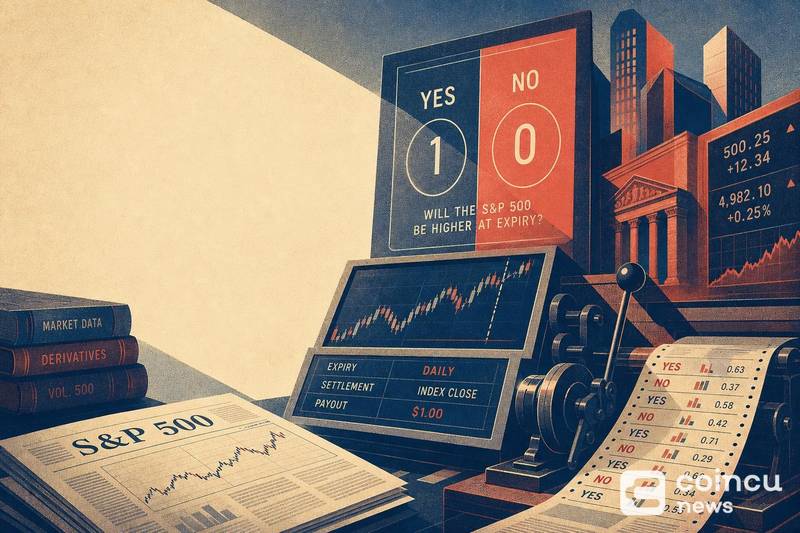
The move positions Cboe as one of the first major regulated exchanges to bridge traditional index derivatives with the prediction market format. The new products fall under a suite the company is branding as Cboe Predicts, which will launch with S&P 500 binary options as its first listed contracts. For related coverage, see Sweet Sweeps Casino Review 2026: Bonus, Games, Is It Legit?.
What Cboe Is Relaunching With S&P 500 Binary Options
S&P 500 binary options are contracts that pay a fixed amount if a specific condition is met at expiration, such as the S&P 500 closing above a set level, and expire worthless if it is not. Unlike standard index options, where the payout scales with the size of the move in the underlying index, binary options offer an all-or-nothing outcome. For related coverage, see Cambrian Raises $6 Million in Seed Round Led by Franklin Templeton and Polychain.
This is not a new concept for Cboe. The exchange previously listed binary options before discontinuing them. The relaunch repackages these instruments under the prediction markets umbrella, reflecting a shift in how exchanges are framing short-duration, outcome-based contracts to attract a new generation of traders. For related coverage, see H100 Shareholders Approve Acquisition Deal to Triple Bitcoin Holdings.
The product is an exchange-listed, regulated financial instrument, distinct from crypto-native prediction tokens. Traders on Cboe Predicts will be operating within the same regulatory framework that governs the exchange’s existing options and futures products.
Why Cboe Is Leaning Into Prediction Markets
Binary contracts are structurally identical to the yes-or-no propositions that define prediction markets. A binary option asking “Will the S&P 500 close above 5,500 on Friday?” functions the same way as a prediction market contract on any other measurable event.
Prediction markets have gained significant traction as traders seek instruments tied to discrete outcomes rather than continuous price exposure. Platforms like Polymarket and Kalshi have demonstrated strong demand for event-driven contracts, particularly around elections, economic data releases, and policy decisions. Cboe’s entry signals that institutional-grade exchanges see this demand as durable, not speculative froth.
For Cboe, the strategic logic is straightforward. The exchange already operates one of the world’s largest options markets. Adding binary-style contracts leverages existing infrastructure, clearing systems, and regulatory approvals while capturing flow that might otherwise go to newer, less regulated venues. The decision to chase a market popularized by Polymarket and Kalshi reflects a competitive dynamic where incumbent exchanges are adapting product design to meet shifting trader preferences.
How Binary Options Differ From Standard Index Derivatives
The key distinction is the payout structure. A standard S&P 500 call option pays the difference between the index level and the strike price at expiration, meaning the payoff increases as the index moves further in the trader’s favor. A binary option pays a fixed dollar amount regardless of how far the index moves past the threshold.
This fixed-payout mechanic makes binary options simpler to understand at the surface level. A trader knows the maximum gain and maximum loss before entering the position. There is no delta hedging, no gamma risk in the traditional sense, and no exercise into an underlying position.
That simplicity, however, does not eliminate risk. Binary options can still produce rapid losses, particularly on short-duration contracts where small moves in the underlying determine a total win or total loss. Traders accustomed to the graduated payoff of vanilla options may underestimate how binary pricing behaves near expiration, where time decay and probability shifts can cause extreme price swings in the contract itself.
Payout Comparison
- Standard S&P 500 option: Pays the difference between the index and the strike, scaling with the size of the move. Risk and reward are variable.
- S&P 500 binary option: Pays a fixed amount if the condition is met, zero if not. Risk is the premium paid; reward is capped at the fixed payout.
What the Relaunch Could Mean for Traders and Exchanges
For active traders, Cboe’s binary options offer regulated access to short-duration, event-style exposure on the S&P 500. This fills a gap between traditional options, which can involve complex Greeks and margin requirements, and unregulated prediction platforms, which may lack institutional safeguards.
The competitive implications extend beyond Cboe. Other major exchanges will likely evaluate whether to launch their own prediction-style products, particularly as Cboe continues expanding its product listings across asset classes. The race to capture event-driven trading flow is accelerating, and product design, listing venue, and regulatory status will all influence where liquidity consolidates.
Adoption constraints remain real. Binary options have a complicated history in the United States, where offshore binary platforms were associated with fraud and aggressive marketing to retail traders. Cboe’s regulated status addresses the legitimacy concern, but the exchange will need to demonstrate that its products attract meaningful liquidity and institutional participation rather than becoming a niche offering.
The broader trend of traditional financial instruments intersecting with crypto-adjacent market structures continues to accelerate. Cboe’s prediction markets push is one data point in a larger convergence where exchanges, regulators, and traders are redefining what counts as a tradeable event.
FAQ: Cboe S&P 500 Binary Options and Prediction Markets
Are binary options the same as standard options?
No. Standard options have a variable payout that scales with the underlying asset’s price movement. Binary options pay a fixed amount if a condition is met and nothing if it is not. The risk profile and trading mechanics differ substantially despite both being derivatives.
Why does Cboe’s move matter for prediction markets?
Cboe is one of the largest and most established derivatives exchanges globally. Its entry into prediction-style products validates the market format and brings regulated infrastructure, institutional clearing, and deep liquidity pools to a category previously dominated by startups and crypto-native platforms.
Who are S&P 500 binary options designed for?
The contracts appeal to traders who want defined-risk exposure to short-term index movements. They are particularly relevant for those who hold a directional view on whether the S&P 500 will be above or below a specific level by a given time, without the complexity of managing a multi-leg options position.
How do Cboe Predicts contracts differ from Polymarket or Kalshi?
Cboe Predicts operates under the existing U.S. securities and derivatives regulatory framework. Polymarket is a crypto-native platform using blockchain settlement, while Kalshi operates as a CFTC-regulated exchange for event contracts. The underlying market structure, settlement mechanism, and regulatory oversight differ across all three.
Disclaimer: This article is for informational purposes only and does not constitute financial or investment advice. Cryptocurrency and digital asset markets carry significant risk. Always do your own research before making decisions.
No tags available.


Other Posts








- China, US Conclude Trade Talks with Focus on Cooperation
- Crypto Weekly: NYSE Backs OKX, Kraken Gets Fed Access, BTC Sells
- Court Upholds Fed’s Rejection of Custodia Bank’s Request
- Former CFO Convicted for $35M Fraudulent Crypto Investment
- DeriW Launches Edge Hour Trading Competition Platform for Derivatives Traders
- Michael Saylor Denies Bitcoin Sell-Off Amid Large BTC Transfer
- Buy Dogecoin on eToro: Step-by-Step Guide for Beginners (2024)
- Kazakhstan Explores Crypto Reserves Backed by National Funds
- JPMorgan Increases Holdings in BlackRock’s Bitcoin ETF
- Nordea Bank Introduces Bitcoin ETP Trading for Nordic Customers
- XRP Spot ETF Launches on Nasdaq Amid Market Fluctuations
- Peter Schiff Challenges Michael Saylor on MSTR’s Business Model
- Thailand Orders Worldcoin to Delete 1.2 Million Biometric Records
- UK Proposes New DeFi Tax Framework to Ease User Burden
- WLFI Under Fire: Analyst Warns Hyperliquid Could Be Next
- Ancient Ethereum Whale Moves $1.19 Billion After Decade
- BlackRock Receives Large Crypto Transfers from Coinbase
- SEC Scrutiny on ALT5 Sigma’s Leadership Disclosure Timing
- Yala Injects $5.5 Million Amid Recovery Efforts
- Radiant Capital Faces $50M Loss in Major Security Breach
- China, US Conclude Trade Talks with Focus on Cooperation
- Crypto Weekly: NYSE Backs OKX, Kraken Gets Fed Access, BTC Sells
- Court Upholds Fed’s Rejection of Custodia Bank’s Request
- Former CFO Convicted for $35M Fraudulent Crypto Investment
- DeriW Launches Edge Hour Trading Competition Platform for Derivatives Traders
- Michael Saylor Denies Bitcoin Sell-Off Amid Large BTC Transfer
- Buy Dogecoin on eToro: Step-by-Step Guide for Beginners (2024)
- Kazakhstan Explores Crypto Reserves Backed by National Funds
- JPMorgan Increases Holdings in BlackRock’s Bitcoin ETF
- Nordea Bank Introduces Bitcoin ETP Trading for Nordic Customers
- XRP Spot ETF Launches on Nasdaq Amid Market Fluctuations
- Peter Schiff Challenges Michael Saylor on MSTR’s Business Model
- Thailand Orders Worldcoin to Delete 1.2 Million Biometric Records
- UK Proposes New DeFi Tax Framework to Ease User Burden
- WLFI Under Fire: Analyst Warns Hyperliquid Could Be Next
- Ancient Ethereum Whale Moves $1.19 Billion After Decade
- BlackRock Receives Large Crypto Transfers from Coinbase
- SEC Scrutiny on ALT5 Sigma’s Leadership Disclosure Timing
- Yala Injects $5.5 Million Amid Recovery Efforts
- Radiant Capital Faces $50M Loss in Major Security Breach
- China, US Conclude Trade Talks with Focus on Cooperation
- Crypto Weekly: NYSE Backs OKX, Kraken Gets Fed Access, BTC Sells
- Court Upholds Fed’s Rejection of Custodia Bank’s Request
- Former CFO Convicted for $35M Fraudulent Crypto Investment
- DeriW Launches Edge Hour Trading Competition Platform for Derivatives Traders
- Michael Saylor Denies Bitcoin Sell-Off Amid Large BTC Transfer
- Buy Dogecoin on eToro: Step-by-Step Guide for Beginners (2024)
- Kazakhstan Explores Crypto Reserves Backed by National Funds
- JPMorgan Increases Holdings in BlackRock’s Bitcoin ETF
- Nordea Bank Introduces Bitcoin ETP Trading for Nordic Customers
- XRP Spot ETF Launches on Nasdaq Amid Market Fluctuations
- Peter Schiff Challenges Michael Saylor on MSTR’s Business Model
- Thailand Orders Worldcoin to Delete 1.2 Million Biometric Records
- UK Proposes New DeFi Tax Framework to Ease User Burden
- WLFI Under Fire: Analyst Warns Hyperliquid Could Be Next
- Ancient Ethereum Whale Moves $1.19 Billion After Decade
- BlackRock Receives Large Crypto Transfers from Coinbase
- SEC Scrutiny on ALT5 Sigma’s Leadership Disclosure Timing
- Yala Injects $5.5 Million Amid Recovery Efforts
- Radiant Capital Faces $50M Loss in Major Security Breach


Over 100 Crypto Projects Shut Down in 2026 as Industry Shakeout Deepens


Cashelix Launches CASX Token Presale to Fuel the Future of Blockchain P2P Transactions
Bybit Sues North Korea and Lazarus Group, Secures Preliminary Injunction Freezing Stolen Assets in Landmark Crypto Asset Recovery Effort