Hong Kong’s monetary authority has granted its first two stablecoin issuer licences, selecting just two applicants from a pool of 36 to launch regulated Hong Kong dollar-referenced stablecoins. The approvals mark a concrete step in the city’s bid to become a hub for regulated digital assets, with implications for how stablecoins, banks, and payment networks compete across Asia and beyond.
Why Hong Kong’s licensing push matters now
On April 10, 2026, the Hong Kong Monetary Authority granted stablecoin issuer licences to Anchorpoint Financial Limited and The Hongkong and Shanghai Banking Corporation Limited, with both licences taking effect the same day. The public register lists Anchorpoint as licence FRS01 and HSBC as licence FRS02.
These are not exploratory sandbox permits. Following the implementation of the Stablecoins Ordinance on August 1, 2025, issuing fiat-referenced stablecoins became a regulated activity in Hong Kong, and a licence is now legally required to operate.
A highly selective first round
The HKMA received first-batch licence applications from 36 entities by the September 30, 2025 deadline. After review, only two were approved.
That approval rate, roughly 5.6%, signals that the HKMA is prioritizing credibility over volume. For exchanges, fintechs, and institutional players watching from outside Hong Kong, the message is clear: regulatory access here requires serious infrastructure and compliance commitments.
Why the region matters
Hong Kong sits at the intersection of mainland China’s capital markets and global digital asset flows. A jurisdiction-level policy shift here influences how exchanges, issuers, and institutions allocate compliance resources across Asia.
HKMA chief executive Eddie Yue described the significance directly:
“The granting of stablecoin issuer licences is an important milestone for the development of digital assets in Hong Kong.”
Eddie Yue, HKMA Chief Executive, via HKMA press release
Both licensed issuers initially plan to issue Hong Kong dollar-referenced stablecoins. The HKMA expects regulated stablecoins in Hong Kong to launch in mid to second half of 2026, giving the market a concrete timeline.
How stablecoin market changes are reshaping the financial stack
The infrastructure layer: issuance, reserves, and redemption
The global stablecoin market stood at $315.781 billion in total market capitalization at the time of this reporting, with USDT holding 58.29% dominance. That concentration means most stablecoin settlement globally runs through a single issuer’s reserve and redemption infrastructure.
Hong Kong’s licensing regime introduces an alternative rail. By requiring reserve transparency, compliance audits, and a formal licence for fiat-referenced issuance, the HKMA is creating a framework where new entrants must meet banking-grade standards before they can issue.
This shifts the competitive dynamic. Instead of stablecoin issuers competing primarily on liquidity and trading pair availability, regulated markets now add compliance depth and reserve quality as differentiators.
User-facing financial effects
For end users, the practical difference emerges in payments, remittances, and cross-border settlement. A regulated HKD-referenced stablecoin issued by HSBC or a Standard Chartered-backed entity carries different counterparty risk than an offshore token.
Anchorpoint Financial, backed by Standard Chartered, plans to issue a token called HKDAP. Standard Chartered CEO Bill Winters framed the product in settlement terms:
“The issuance of HKDAP by Anchorpoint provides a powerful regulated medium of exchange that will further the rewiring of our financial markets.”
Bill Winters, Standard Chartered CEO, via Standard Chartered press release
If regulated HKD stablecoins gain traction, they could reduce dependence on USD-denominated tokens for Asia-Pacific settlement, a structural change in how digital asset liquidity flows through the region.
Who is most likely to shape the next generation of finance?
Banks with digital asset ambitions
HSBC’s licence (FRS02) makes it one of the first global banks to hold a stablecoin issuer licence anywhere. Banks that combine existing deposit infrastructure with stablecoin issuance authority can offer seamless on-ramps and off-ramps without third-party token intermediaries.
This is the model that institutional investors have been waiting for. Much like how BlackRock’s involvement in Bitcoin ETF filings signaled institutional legitimacy in the ETF space, a bank-issued stablecoin under formal regulatory licence changes the risk calculus for corporate treasury adoption.
Licensed fintechs and joint ventures
Anchorpoint Financial (FRS01) represents the joint-venture model, combining Standard Chartered’s banking relationships with fintech execution. This structure gives fintech operators access to banking-grade compliance while giving banks exposure to digital asset distribution channels.
The 34 rejected applicants in this first round may reapply or pivot to other jurisdictions. Those that build compliance infrastructure meeting HKMA standards, even without an immediate licence, position themselves for future rounds.
Exchanges and payment networks
Crypto exchanges operating in Hong Kong now face a market where regulated stablecoins will compete with existing offshore tokens. Exchanges that integrate licensed HKD stablecoins early gain a compliance advantage with institutional clients. Payment networks that can bridge regulated stablecoins to merchant settlement gain a new rail.
The competitive question is distribution. Issuance authority alone does not guarantee adoption; whoever controls the on-ramps, trading pairs, and merchant acceptance points will determine how quickly regulated stablecoins gain market share. Recent developments like new platform fee models in the broader crypto ecosystem show how infrastructure design shapes user adoption.
What could slow adoption or shift the balance of power?
Compliance burden and operational cost
The 36-to-2 approval rate illustrates how high the bar is. For smaller issuers, the cost of meeting HKMA reserve, audit, and reporting requirements may exceed the revenue potential of a regional stablecoin, particularly in the early years before significant transaction volume develops.
Regulation raises barriers to entry by design. That protects consumers but also concentrates issuance authority among well-capitalized incumbents, potentially limiting the diversity of stablecoin products available.
Market fragmentation and interoperability
A regulated HKD stablecoin is useful in Hong Kong-connected markets. But the global stablecoin market, with its $315.781 billion in total capitalization and heavy USD dominance, operates on different rails. Without cross-border recognition agreements or interoperability standards, regulated Hong Kong stablecoins risk remaining regional tools rather than global settlement instruments.
The broader regulatory environment adds complexity. While Hong Kong moves forward with licensing, other jurisdictions are developing their own frameworks. Entities operating across borders, including those navigating complex financial portfolios spanning traditional and crypto assets, must comply with overlapping and sometimes conflicting regulatory regimes.
Trust takes time
Regulation provides a framework, but it does not automatically generate user trust or merchant adoption. The crypto market’s current sentiment, reflected in a Fear and Greed Index reading of 21 (Extreme Fear), suggests that broader market conditions may slow the enthusiasm for new financial products regardless of their regulatory backing.
The HKMA’s timeline, expecting regulated stablecoin launches in mid to second half of 2026, builds in a runway for issuers to develop distribution and for the market to stabilize. Whether that timeline holds depends on how quickly Anchorpoint and HSBC can move from licence to live product.
FAQ: Hong Kong stablecoin licences and market impact
What are Hong Kong’s stablecoin licences?
Under the Stablecoins Ordinance, which took effect August 1, 2025, anyone issuing fiat-referenced stablecoins in Hong Kong must hold a licence from the HKMA. The first two licences were granted on April 10, 2026 to Anchorpoint Financial Limited and HSBC.
Why were only two applicants approved from 36?
The HKMA has not disclosed specific rejection reasons, but the low approval rate indicates stringent requirements around reserves, governance, and operational readiness. The selective approach prioritizes market credibility over rapid expansion.
What type of stablecoins will be issued?
Both approved issuers plan to issue Hong Kong dollar-referenced stablecoins initially. Anchorpoint’s planned token is called HKDAP. The HKMA expects these regulated stablecoins to launch in mid to second half of 2026.
How does this affect the broader stablecoin market?
The global stablecoin market is heavily concentrated in USD-referenced tokens, with USDT alone holding 58.29% dominance. Hong Kong’s HKD stablecoins introduce a regulated alternative currency denomination, which could gradually diversify settlement options in Asia-Pacific markets.
Who benefits most from this development?
In the near term, the two approved issuers, HSBC and Standard Chartered-backed Anchorpoint, hold a first-mover advantage. Exchanges and payment networks that integrate these regulated stablecoins early will gain a compliance edge with institutional clients in the region.
Disclaimer: This article is for informational purposes only and does not constitute financial or investment advice. Cryptocurrency and digital asset markets carry significant risk. Always do your own research before making decisions.
No tags available.


Other Posts







- China, US Conclude Trade Talks with Focus on Cooperation
- Crypto Weekly: NYSE Backs OKX, Kraken Gets Fed Access, BTC Sells
- Court Upholds Fed’s Rejection of Custodia Bank’s Request
- Former CFO Convicted for $35M Fraudulent Crypto Investment
- DeriW Launches Edge Hour Trading Competition Platform for Derivatives Traders
- Michael Saylor Denies Bitcoin Sell-Off Amid Large BTC Transfer
- Buy Dogecoin on eToro: Step-by-Step Guide for Beginners (2024)
- Kazakhstan Explores Crypto Reserves Backed by National Funds
- JPMorgan Increases Holdings in BlackRock’s Bitcoin ETF
- Nordea Bank Introduces Bitcoin ETP Trading for Nordic Customers
- XRP Spot ETF Launches on Nasdaq Amid Market Fluctuations
- Peter Schiff Challenges Michael Saylor on MSTR’s Business Model
- Thailand Orders Worldcoin to Delete 1.2 Million Biometric Records
- UK Proposes New DeFi Tax Framework to Ease User Burden
- WLFI Under Fire: Analyst Warns Hyperliquid Could Be Next
- Ancient Ethereum Whale Moves $1.19 Billion After Decade
- BlackRock Receives Large Crypto Transfers from Coinbase
- SEC Scrutiny on ALT5 Sigma’s Leadership Disclosure Timing
- Yala Injects $5.5 Million Amid Recovery Efforts
- Radiant Capital Faces $50M Loss in Major Security Breach
- China, US Conclude Trade Talks with Focus on Cooperation
- Crypto Weekly: NYSE Backs OKX, Kraken Gets Fed Access, BTC Sells
- Court Upholds Fed’s Rejection of Custodia Bank’s Request
- Former CFO Convicted for $35M Fraudulent Crypto Investment
- DeriW Launches Edge Hour Trading Competition Platform for Derivatives Traders
- Michael Saylor Denies Bitcoin Sell-Off Amid Large BTC Transfer
- Buy Dogecoin on eToro: Step-by-Step Guide for Beginners (2024)
- Kazakhstan Explores Crypto Reserves Backed by National Funds
- JPMorgan Increases Holdings in BlackRock’s Bitcoin ETF
- Nordea Bank Introduces Bitcoin ETP Trading for Nordic Customers
- XRP Spot ETF Launches on Nasdaq Amid Market Fluctuations
- Peter Schiff Challenges Michael Saylor on MSTR’s Business Model
- Thailand Orders Worldcoin to Delete 1.2 Million Biometric Records
- UK Proposes New DeFi Tax Framework to Ease User Burden
- WLFI Under Fire: Analyst Warns Hyperliquid Could Be Next
- Ancient Ethereum Whale Moves $1.19 Billion After Decade
- BlackRock Receives Large Crypto Transfers from Coinbase
- SEC Scrutiny on ALT5 Sigma’s Leadership Disclosure Timing
- Yala Injects $5.5 Million Amid Recovery Efforts
- Radiant Capital Faces $50M Loss in Major Security Breach
- China, US Conclude Trade Talks with Focus on Cooperation
- Crypto Weekly: NYSE Backs OKX, Kraken Gets Fed Access, BTC Sells
- Court Upholds Fed’s Rejection of Custodia Bank’s Request
- Former CFO Convicted for $35M Fraudulent Crypto Investment
- DeriW Launches Edge Hour Trading Competition Platform for Derivatives Traders
- Michael Saylor Denies Bitcoin Sell-Off Amid Large BTC Transfer
- Buy Dogecoin on eToro: Step-by-Step Guide for Beginners (2024)
- Kazakhstan Explores Crypto Reserves Backed by National Funds
- JPMorgan Increases Holdings in BlackRock’s Bitcoin ETF
- Nordea Bank Introduces Bitcoin ETP Trading for Nordic Customers
- XRP Spot ETF Launches on Nasdaq Amid Market Fluctuations
- Peter Schiff Challenges Michael Saylor on MSTR’s Business Model
- Thailand Orders Worldcoin to Delete 1.2 Million Biometric Records
- UK Proposes New DeFi Tax Framework to Ease User Burden
- WLFI Under Fire: Analyst Warns Hyperliquid Could Be Next
- Ancient Ethereum Whale Moves $1.19 Billion After Decade
- BlackRock Receives Large Crypto Transfers from Coinbase
- SEC Scrutiny on ALT5 Sigma’s Leadership Disclosure Timing
- Yala Injects $5.5 Million Amid Recovery Efforts
- Radiant Capital Faces $50M Loss in Major Security Breach

Binance Wallet Adds Limit Orders on Ethereum and Base for Web and App Users


EthSystems Launches to Build Privacy Solutions for Institutions on Ethereum
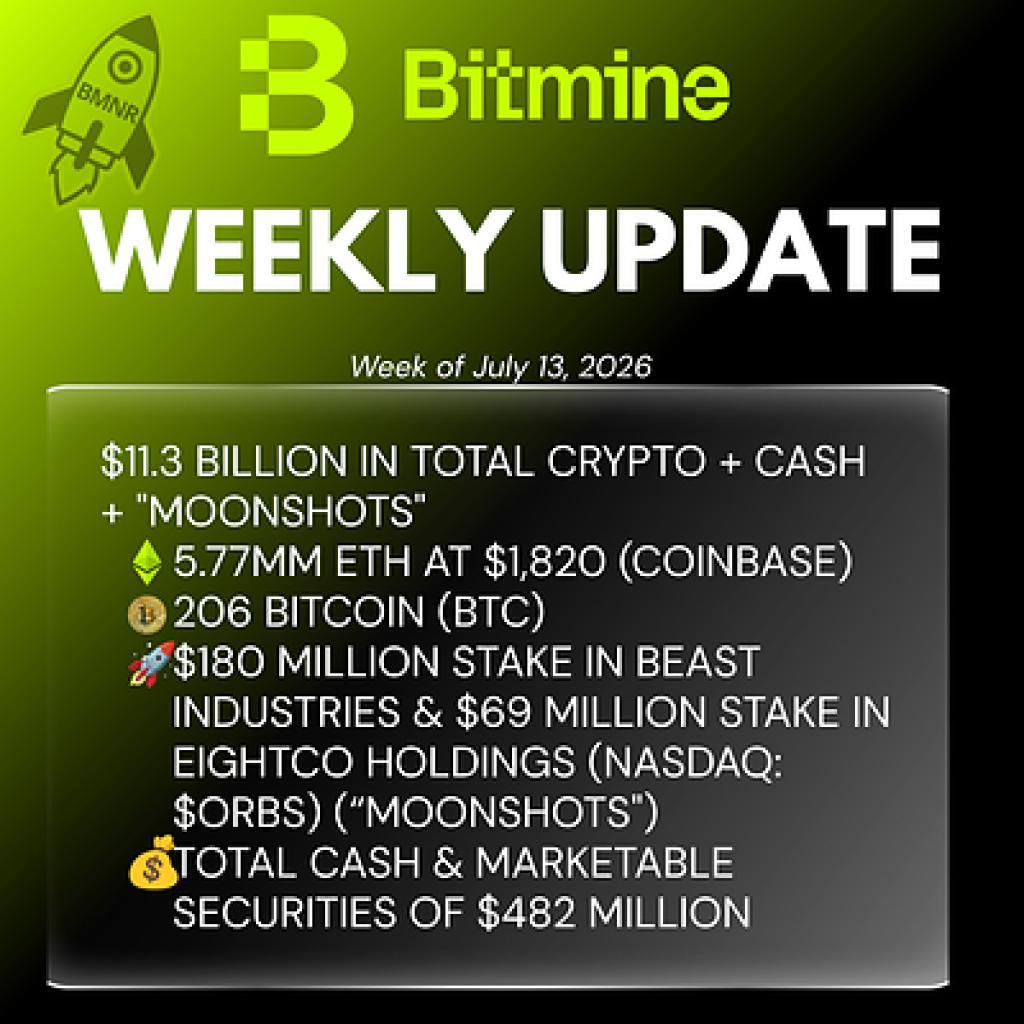
Bitmine Immersion Technologies (BMNR) Announces ETH Holdings Reach 5.77 Million Tokens, and Total Crypto and Total Cash Holdings of $11.3 Billion