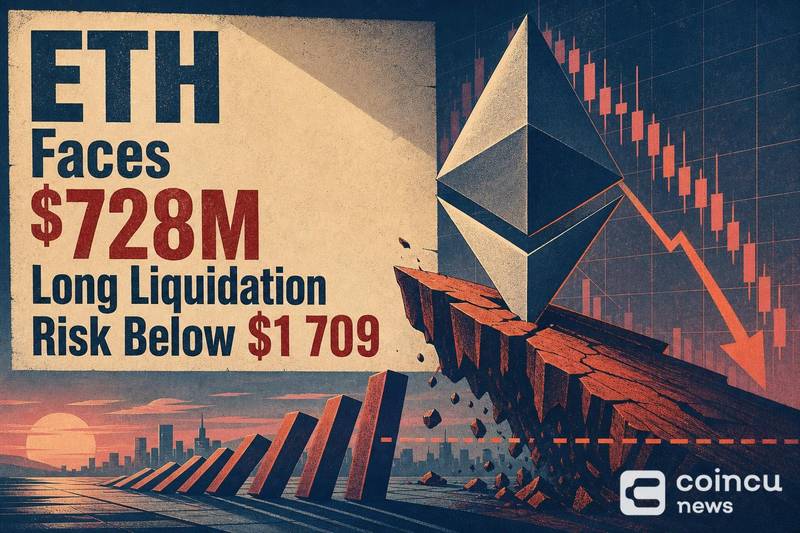
If ETH falls below $1,709, cumulative long liquidation intensity on mainstream centralized exchanges could reach $728 million, according to a widely circulated market claim. The figure represents a conditional risk scenario, not a confirmed liquidation event, and the underlying data remains only partially verified.
What the $1,709 Threshold and $728 Million Figure Actually Mean
The claim identifies $1,709 as a specific ETH price level where accumulated leveraged long positions across major centralized exchanges would face forced closure. The reported $728 million in cumulative long liquidation intensity refers to the estimated notional value of those positions, not realized losses. For related coverage, see New Wallet Deposits $1.995M USDC to HyperLiquid, Opens $9.74M Gold Long.
This is a conditional scenario. No liquidation event of this size has been confirmed. The figure describes what could happen if ETH trades below the cited threshold, based on the current distribution of leveraged positions on mainstream CEXs. For related coverage, see On-Chain Tokenized Stock Trading Volume Hits Record $3.86B in June.
Liquidation intensity estimates aggregate open positions across multiple exchanges and leverage tiers. They represent a snapshot of current positioning, meaning the actual figure shifts continuously as traders open, close, or adjust their positions. For related coverage, see Berachain Launches PoL Next on Mainnet, Shifting BGT to sWBERA.
Why the Trigger Level Is More Actionable Than the Dollar Figure
For derivatives traders, the $1,709 price level is the key variable. Liquidation clusters at specific price points create zones of concentrated risk, where a price move through the level can trigger a rapid sequence of forced closures. For related coverage, see Crypto Liquidations Top $50M in One Hour, BTC at $11.27M.
The distinction between liquidation risk and realized liquidation matters. Risk describes the positioning setup; realization depends on whether price actually reaches and sustains below the trigger. Traders monitoring this level watch for proximity, not just the headline dollar amount. For related coverage, see MiCA Implementation: 21 Stablecoin Issuers, 270 CASPs Approved.
As ETH approaches a liquidation cluster, the probability of cascading forced sales increases. Each liquidation adds sell pressure, which can push price further into the cluster, similar to dynamics seen in recent crypto liquidation events where over $50 million was liquidated in a single hour.
This feedback loop is why derivatives traders treat dense liquidation zones as significant support or resistance levels, independent of spot market fundamentals.
How Incomplete Verification Changes the Story
The supporting evidence for this claim has not been fully captured. The primary data source, the Coinglass ETH liquidation heatmap, was not successfully retrieved during the research phase.
Several critical details remain unconfirmed. These include which specific exchanges are included in the “mainstream CEX” aggregate, what time window the estimate covers, and what methodology was used to calculate the $728 million intensity figure.
Liquidation-intensity estimates are highly time-sensitive. Positioning changes constantly as traders react to price movements, funding rate shifts, and broader market conditions. A figure calculated at one point can look materially different hours later.
Without verified access to the underlying heatmap data, the claim should be treated as a market signal worth monitoring rather than a confirmed setup.
What to Watch Before Treating This as a Cascade Signal
Traders evaluating whether this scenario could materialize should track several concrete signals. The first is whether ETH actually trades into or below the $1,709 zone. A brief wick below that level and a sustained breakdown carry different liquidation implications.
The second signal is independent confirmation. If a follow-up source verifies the same concentration of long positions near $1,709, the claim gains credibility. Without corroboration, a single estimate from one data provider carries limited weight.
The third signal is whether broader CEX liquidation volumes accelerate as the threshold is tested. Isolated ETH liquidations are different from a market-wide cascade. Watching leveraged positioning on platforms like HyperLiquid can provide additional context on derivatives market sentiment.
Funding rates across major exchanges offer a fourth indicator. Persistently positive funding suggests crowded long positioning, which would support the premise of concentrated liquidation risk below current levels.
FAQ: ETH Long Liquidation Risk Below $1,709
What does long liquidation intensity mean in this context?
Long liquidation intensity refers to the estimated notional value of leveraged long positions that would be forcibly closed if ETH drops below a specific price level. It measures concentrated risk, not realized losses.
Has ETH already triggered the reported liquidation zone?
No. The claim describes a conditional scenario. The $728 million figure represents what could happen if ETH trades below $1,709, not what has already occurred.
Why does the $1,709 level matter to derivatives traders?
Dense clusters of liquidation orders at a specific price create zones where forced selling can accelerate a price decline. Traders watch these levels because a move through them can trigger cascading liquidations that amplify downside volatility.
Can the reported $728 million figure change quickly?
Yes. Liquidation intensity estimates are snapshots of current positioning. As traders open or close leveraged positions, the concentration of risk at any given price level shifts. The figure could be materially higher or lower within hours of the original estimate.
Disclaimer: This article is for informational purposes only and does not constitute financial or investment advice. Cryptocurrency and digital asset markets carry significant risk. Always do your own research before making decisions.
No tags available.


Other Posts








- China, US Conclude Trade Talks with Focus on Cooperation
- Court Upholds Fed’s Rejection of Custodia Bank’s Request
- Crypto Weekly: NYSE Backs OKX, Kraken Gets Fed Access, BTC Sells
- Former CFO Convicted for $35M Fraudulent Crypto Investment
- DeriW Launches Edge Hour Trading Competition Platform for Derivatives Traders
- Michael Saylor Denies Bitcoin Sell-Off Amid Large BTC Transfer
- Buy Dogecoin on eToro: Step-by-Step Guide for Beginners (2024)
- Kazakhstan Explores Crypto Reserves Backed by National Funds
- JPMorgan Increases Holdings in BlackRock’s Bitcoin ETF
- Nordea Bank Introduces Bitcoin ETP Trading for Nordic Customers
- XRP Spot ETF Launches on Nasdaq Amid Market Fluctuations
- Peter Schiff Challenges Michael Saylor on MSTR’s Business Model
- Thailand Orders Worldcoin to Delete 1.2 Million Biometric Records
- UK Proposes New DeFi Tax Framework to Ease User Burden
- WLFI Under Fire: Analyst Warns Hyperliquid Could Be Next
- Ancient Ethereum Whale Moves $1.19 Billion After Decade
- BlackRock Receives Large Crypto Transfers from Coinbase
- SEC Scrutiny on ALT5 Sigma’s Leadership Disclosure Timing
- Yala Injects $5.5 Million Amid Recovery Efforts
- Radiant Capital Faces $50M Loss in Major Security Breach
- China, US Conclude Trade Talks with Focus on Cooperation
- Court Upholds Fed’s Rejection of Custodia Bank’s Request
- Crypto Weekly: NYSE Backs OKX, Kraken Gets Fed Access, BTC Sells
- Former CFO Convicted for $35M Fraudulent Crypto Investment
- DeriW Launches Edge Hour Trading Competition Platform for Derivatives Traders
- Michael Saylor Denies Bitcoin Sell-Off Amid Large BTC Transfer
- Buy Dogecoin on eToro: Step-by-Step Guide for Beginners (2024)
- Kazakhstan Explores Crypto Reserves Backed by National Funds
- JPMorgan Increases Holdings in BlackRock’s Bitcoin ETF
- Nordea Bank Introduces Bitcoin ETP Trading for Nordic Customers
- XRP Spot ETF Launches on Nasdaq Amid Market Fluctuations
- Peter Schiff Challenges Michael Saylor on MSTR’s Business Model
- Thailand Orders Worldcoin to Delete 1.2 Million Biometric Records
- UK Proposes New DeFi Tax Framework to Ease User Burden
- WLFI Under Fire: Analyst Warns Hyperliquid Could Be Next
- Ancient Ethereum Whale Moves $1.19 Billion After Decade
- BlackRock Receives Large Crypto Transfers from Coinbase
- SEC Scrutiny on ALT5 Sigma’s Leadership Disclosure Timing
- Yala Injects $5.5 Million Amid Recovery Efforts
- Radiant Capital Faces $50M Loss in Major Security Breach
- China, US Conclude Trade Talks with Focus on Cooperation
- Court Upholds Fed’s Rejection of Custodia Bank’s Request
- Crypto Weekly: NYSE Backs OKX, Kraken Gets Fed Access, BTC Sells
- Former CFO Convicted for $35M Fraudulent Crypto Investment
- DeriW Launches Edge Hour Trading Competition Platform for Derivatives Traders
- Michael Saylor Denies Bitcoin Sell-Off Amid Large BTC Transfer
- Buy Dogecoin on eToro: Step-by-Step Guide for Beginners (2024)
- Kazakhstan Explores Crypto Reserves Backed by National Funds
- JPMorgan Increases Holdings in BlackRock’s Bitcoin ETF
- Nordea Bank Introduces Bitcoin ETP Trading for Nordic Customers
- XRP Spot ETF Launches on Nasdaq Amid Market Fluctuations
- Peter Schiff Challenges Michael Saylor on MSTR’s Business Model
- Thailand Orders Worldcoin to Delete 1.2 Million Biometric Records
- UK Proposes New DeFi Tax Framework to Ease User Burden
- WLFI Under Fire: Analyst Warns Hyperliquid Could Be Next
- Ancient Ethereum Whale Moves $1.19 Billion After Decade
- BlackRock Receives Large Crypto Transfers from Coinbase
- SEC Scrutiny on ALT5 Sigma’s Leadership Disclosure Timing
- Yala Injects $5.5 Million Amid Recovery Efforts
- Radiant Capital Faces $50M Loss in Major Security Breach


Bitcoin’s $116M Self-Custody Wake-Up Call Raises ETF Questions

SafePal Data Breach Exposes Nearly 40,000 Customers’ Order Info

BiggerZ: Building a Fairness-First Crypto Casino, Sportsbook and Prediction Markets Platform
Bitmine Immersion Technologies Announces Record and Payment Dates for Cash Dividends on 9.50% Series A Perpetual Preferred Stock