98.6% of AI Agent Crypto Transactions Are Settled in USDC: Report
A new report from crypto market maker Keyrock found that 98.6% of AI agent crypto transactions were settled in USDC, underscoring the stablecoin’s near-total grip on the emerging machine-to-machine payments economy.
The Keyrock report tracked AI agent activity between May 2025 and April 2026, recording over $73 million in settlement volume across 176 million blockchain transactions. The dataset represents one of the largest publicly available analyses of autonomous agent payment behavior on-chain.
USDC settled nearly every AI agent transaction in the dataset
Of those 176 million machine-driven transactions, 98.6% settled in USDC. The concentration is striking even by stablecoin standards, where network effects tend to entrench incumbents, and suggests that AI agent developers have converged on a single settlement asset rather than distributing across multiple stablecoins.
The term “settled in USDC” means the final value transfer between agents, or between an agent and a service, was denominated and completed in Circle’s dollar-pegged stablecoin. This is distinct from broader crypto trading volume; it reflects the payment rail agents actually use to close transactions.
The report also found that 76% of agent payment activity fell below the $0.30 card-fee floor. That threshold is the minimum cost at which traditional card networks can profitably process a transaction, meaning three-quarters of the agent economy’s payments are too small for Visa or Mastercard rails to handle economically.
It is worth emphasizing that these figures come from a single report. Keyrock is a prominent crypto market maker, but the article is reporting on its findings, not independently verifying transaction-level data.
Why AI agents appear to favor USDC over other stablecoins
A 98.6% share implies that agent developers are not choosing between stablecoins at all. USDC has likely become the default for several reinforcing reasons, though the report does not explicitly rank them.
First, settlement predictability matters more for machines than for humans. An AI agent executing thousands of micropayments per day needs a token with tight peg stability and consistent on-chain liquidity. USDC’s market cap sits above $76.4 billion, providing deep liquidity across multiple chains.
Second, USDC’s regulatory positioning may play a role. Circle publishes monthly reserve attestations and has pursued compliance-forward strategies in both the U.S. and Europe. For agent frameworks that need to satisfy compliance requirements, a regulated stablecoin reduces integration risk, similar to how stablecoin depegging events have historically pushed developers toward assets with transparent reserves.
Third, operational convenience likely compounds the effect. Once early agent protocols standardized on USDC, subsequent developers had strong incentives to follow, creating a self-reinforcing cycle where tooling, documentation, and liquidity all favor the incumbent asset.
The demand-supply imbalance inside the agent economy
Earlier data from Enterprise Onchain, which tracked machine-to-machine transactions through February 2026, recorded 140 million transactions totaling $43 million over nine months. That figure has since grown to Keyrock’s $73 million across 176 million transactions, indicating accelerating adoption.
Enterprise Onchain’s dataset also revealed a significant structural imbalance: 406,700 buyer addresses versus just 81,000 seller addresses. That roughly 5:1 ratio suggests far more agents are consuming services than providing them, a dynamic that helps explain why a single stablecoin can dominate settlement even before merchant-side competition materializes.
When buyers vastly outnumber sellers, sellers have little incentive to support multiple payment tokens. Accepting one stablecoin with deep liquidity is simpler than managing several, and the buyer side follows. This rising on-chain transaction activity mirrors patterns seen in traditional payments, where network effects tend to produce winner-take-most outcomes in settlement layers.
What this means for stablecoin competition and crypto infrastructure
If AI agent transactions continue scaling at the pace Keyrock’s data implies, the machine-payments segment could become a meaningful source of stablecoin demand independent of human trading activity. The 176 million transactions recorded in just 12 months already exceed the annual transaction count of many mid-tier payment networks.
For competing stablecoins, including Tether’s USDT, the data presents a challenge. USDT dominates crypto trading volume globally, but agent developers appear to have made a different choice for settlement. Whether that gap narrows as the agent economy matures, or widens as USDC’s first-mover advantage compounds, will depend on factors like chain support, fee structures, and regulatory developments.
Both the EU’s MiCA framework and the U.S. GENIUS Act are expected to take effect around mid-2026, but neither directly addresses autonomous machine-to-machine payments, agent identity, or liability. The regulatory gap means agent payment infrastructure is growing in a space where rules have not yet caught up, a dynamic familiar to anyone who watched crypto markets evolve ahead of regulatory frameworks in prior cycles.
Key limitations behind the headline figure
The 98.6% figure is precise but comes with important caveats. Keyrock’s methodology, including which chains were monitored, how “AI agent” transactions were identified, and how the dataset was scoped, shapes the result. A different classification system or chain coverage could produce different numbers.
Settlement dominance is also not the same as total user adoption or market capitalization share. USDC may dominate agent-to-agent payments while holding a smaller share of overall stablecoin supply than USDT. The statistic describes a specific use case, not the entire stablecoin market.
Geographic coverage is another unknown. If the dataset skews toward U.S.- or Europe-based agent frameworks, it may undercount activity in regions where USDT is more commonly integrated. Readers should treat the figure as a strong signal from a credible source rather than a definitive census of all AI agent payment behavior globally.
The Fear and Greed Index currently reads 25, classified as Extreme Fear, suggesting that broader market sentiment remains cautious even as this infrastructure-level adoption story unfolds.
FAQ: AI agent crypto transactions and USDC
What are AI agent crypto transactions?
AI agent crypto transactions are blockchain payments initiated and settled by autonomous software agents rather than human users. These agents purchase compute, data, API access, or other digital services from each other, using crypto rails instead of traditional payment networks.
Why are stablecoins used for agent settlement?
Stablecoins eliminate price volatility from the transaction, which matters for agents executing high volumes of micropayments. An agent paying $0.05 for an API call needs the payment token to be worth $0.05 when it arrives, not $0.04 or $0.06. Dollar-pegged stablecoins provide that certainty.
Does 98.6% mean USDC dominates every part of the AI crypto economy?
No. The figure applies specifically to settlement of machine-to-machine payments in Keyrock’s dataset. AI agents may hold, trade, or interact with many other tokens. The statistic reflects a payment preference, not total economic activity.
Disclaimer: This article is for informational purposes only and does not constitute financial or investment advice. Cryptocurrency and digital asset markets carry significant risk. Always do your own research before making decisions.
No tags available.


Other Posts








- China, US Conclude Trade Talks with Focus on Cooperation
- Crypto Weekly: NYSE Backs OKX, Kraken Gets Fed Access, BTC Sells
- Court Upholds Fed’s Rejection of Custodia Bank’s Request
- DeriW Launches Edge Hour Trading Competition Platform for Derivatives Traders
- Former CFO Convicted for $35M Fraudulent Crypto Investment
- Michael Saylor Denies Bitcoin Sell-Off Amid Large BTC Transfer
- Buy Dogecoin on eToro: Step-by-Step Guide for Beginners (2024)
- Kazakhstan Explores Crypto Reserves Backed by National Funds
- JPMorgan Increases Holdings in BlackRock’s Bitcoin ETF
- Nordea Bank Introduces Bitcoin ETP Trading for Nordic Customers
- XRP Spot ETF Launches on Nasdaq Amid Market Fluctuations
- Peter Schiff Challenges Michael Saylor on MSTR’s Business Model
- Thailand Orders Worldcoin to Delete 1.2 Million Biometric Records
- UK Proposes New DeFi Tax Framework to Ease User Burden
- WLFI Under Fire: Analyst Warns Hyperliquid Could Be Next
- Ancient Ethereum Whale Moves $1.19 Billion After Decade
- BlackRock Receives Large Crypto Transfers from Coinbase
- SEC Scrutiny on ALT5 Sigma’s Leadership Disclosure Timing
- Yala Injects $5.5 Million Amid Recovery Efforts
- Radiant Capital Faces $50M Loss in Major Security Breach
- China, US Conclude Trade Talks with Focus on Cooperation
- Crypto Weekly: NYSE Backs OKX, Kraken Gets Fed Access, BTC Sells
- Court Upholds Fed’s Rejection of Custodia Bank’s Request
- DeriW Launches Edge Hour Trading Competition Platform for Derivatives Traders
- Former CFO Convicted for $35M Fraudulent Crypto Investment
- Michael Saylor Denies Bitcoin Sell-Off Amid Large BTC Transfer
- Buy Dogecoin on eToro: Step-by-Step Guide for Beginners (2024)
- Kazakhstan Explores Crypto Reserves Backed by National Funds
- JPMorgan Increases Holdings in BlackRock’s Bitcoin ETF
- Nordea Bank Introduces Bitcoin ETP Trading for Nordic Customers
- XRP Spot ETF Launches on Nasdaq Amid Market Fluctuations
- Peter Schiff Challenges Michael Saylor on MSTR’s Business Model
- Thailand Orders Worldcoin to Delete 1.2 Million Biometric Records
- UK Proposes New DeFi Tax Framework to Ease User Burden
- WLFI Under Fire: Analyst Warns Hyperliquid Could Be Next
- Ancient Ethereum Whale Moves $1.19 Billion After Decade
- BlackRock Receives Large Crypto Transfers from Coinbase
- SEC Scrutiny on ALT5 Sigma’s Leadership Disclosure Timing
- Yala Injects $5.5 Million Amid Recovery Efforts
- Radiant Capital Faces $50M Loss in Major Security Breach
- China, US Conclude Trade Talks with Focus on Cooperation
- Crypto Weekly: NYSE Backs OKX, Kraken Gets Fed Access, BTC Sells
- Court Upholds Fed’s Rejection of Custodia Bank’s Request
- DeriW Launches Edge Hour Trading Competition Platform for Derivatives Traders
- Former CFO Convicted for $35M Fraudulent Crypto Investment
- Michael Saylor Denies Bitcoin Sell-Off Amid Large BTC Transfer
- Buy Dogecoin on eToro: Step-by-Step Guide for Beginners (2024)
- Kazakhstan Explores Crypto Reserves Backed by National Funds
- JPMorgan Increases Holdings in BlackRock’s Bitcoin ETF
- Nordea Bank Introduces Bitcoin ETP Trading for Nordic Customers
- XRP Spot ETF Launches on Nasdaq Amid Market Fluctuations
- Peter Schiff Challenges Michael Saylor on MSTR’s Business Model
- Thailand Orders Worldcoin to Delete 1.2 Million Biometric Records
- UK Proposes New DeFi Tax Framework to Ease User Burden
- WLFI Under Fire: Analyst Warns Hyperliquid Could Be Next
- Ancient Ethereum Whale Moves $1.19 Billion After Decade
- BlackRock Receives Large Crypto Transfers from Coinbase
- SEC Scrutiny on ALT5 Sigma’s Leadership Disclosure Timing
- Yala Injects $5.5 Million Amid Recovery Efforts
- Radiant Capital Faces $50M Loss in Major Security Breach

Prediction Market World Announces Migration From Solana to Robinhood Chain

Binance to Adjust Minimum Price Movement for Six U-Margined Perpetual Contracts

Bitcoin Suisse Advances Middle East Expansion, Receives Financial Services Permission in Abu Dhabi
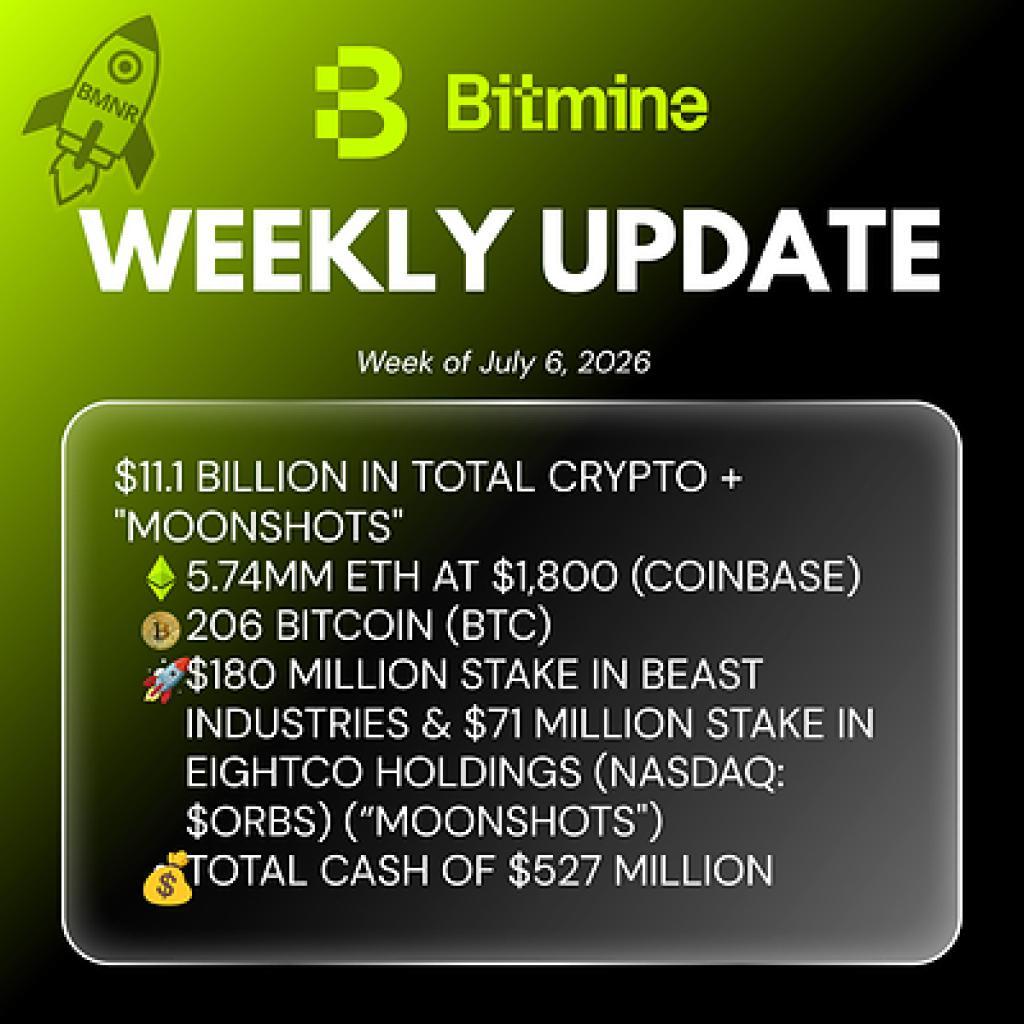
Bitmine Immersion Technologies (BMNR) Announces Total Crypto and Cash Holdings Top $11.1 Billion Now