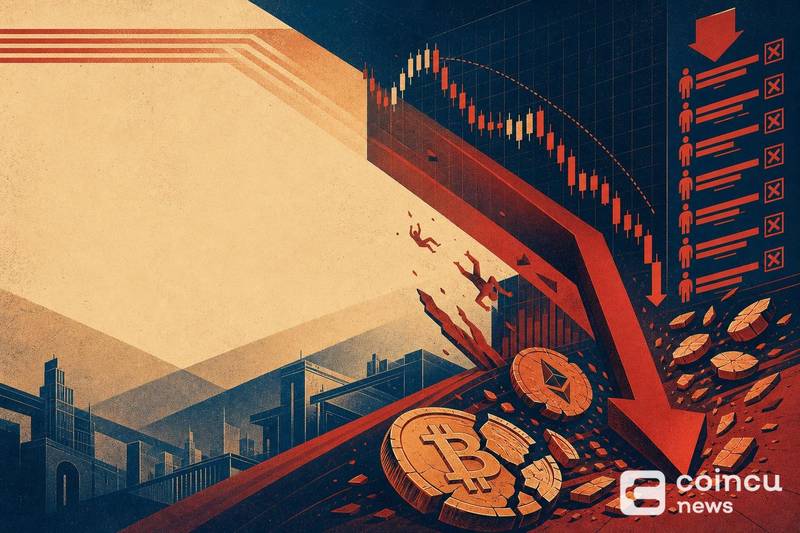

Crypto market liquidations reached $1.61 billion over a 24-hour period, with roughly 85% of the forced closures hitting long positions. The wave of liquidations marks one of the sharper leveraged unwinds in recent months, catching bullish traders off guard as prices reversed across major tokens.
What triggered $1.61 billion in crypto liquidations
Liquidations occur when a leveraged trading position loses enough value that the exchange forcibly closes it to prevent further losses. Traders using leverage borrow funds to amplify their exposure, but that amplification works in both directions.
The $1.61 billion in forced closures accumulated within a single 24-hour window, according to Coinglass liquidation data. The speed and scale of the event point to a marketwide sell-off rather than an isolated collapse in a single asset.

A CoinDesk report noted that ETH, SOL, and DOGE each dropped roughly 9% during the event, confirming that the pain spread well beyond Bitcoin. Twenty-four-hour liquidation spikes of this magnitude matter because they often reset positioning across the derivatives market, clearing out crowded trades and shifting short-term sentiment.
Why 85% of liquidations came from long positions
A long position is a bet that an asset’s price will rise. When 85% of the liquidation volume comes from longs, it signals that the market was heavily skewed toward bullish bets before the reversal hit.
Leverage magnifies downside risk during sharp sell-offs. A trader using 10x leverage on a long position faces a forced closure after just a 10% price decline. When multiple leveraged longs get liquidated simultaneously, the forced selling creates additional downward pressure.
That cascading effect is what turns a moderate price dip into a full liquidation wave. As positions get closed, sell orders flood the order book, pushing prices lower and triggering the next tier of liquidations. The lopsided 85% long ratio suggests traders had been aggressively positioned for continued upside heading into the move, a pattern consistent with recent bullish sentiment around institutional rotation into Bitcoin.

Which parts of the market were hit hardest
Marketwide liquidation events typically concentrate in the most actively traded perpetual futures pairs. Bitcoin and Ethereum perpetuals carry the deepest liquidity and highest open interest, making them the largest single sources of liquidation volume during broad sell-offs.
Higher-volatility altcoins, however, often experience sharper percentage declines during leveraged unwinds. The reported 9% drops in ETH, SOL, and DOGE illustrate how altcoin positions can face steeper forced closures than Bitcoin during the same event. Traders holding leveraged long positions in these tokens would have hit liquidation thresholds faster than those in less volatile pairs.
The breadth of the sell-off also underscores the interconnected nature of crypto derivatives markets. Events like this tend to ripple through exchange order books, as recent Ethereum spot ETF outflows extending over 17 days had already signaled weakening demand on the spot side.
What the liquidation spike signals for short-term sentiment
A long-dominant liquidation event means bullish positioning was aggressively reset. Open interest across major pairs typically drops sharply after a wave of this size, as leveraged traders either exit or reduce exposure.
Large forced unwinds can mark either panic exhaustion, where the worst of the selling is over, or the beginning of deeper weakness if the underlying catalyst persists. The distinction usually becomes clear in the sessions that follow, based on whether new leveraged positions rebuild quickly or traders remain cautious.
After major liquidation events, derivatives traders typically watch funding rates, open interest recovery, and spot volume for signals. Positive funding rates returning quickly would suggest buyers are stepping back in. Flat or negative rates would indicate the market is still digesting the shock. Concerns about broader market structure, including reports of exchanges freezing funds tied to fraud networks, can compound risk-off sentiment during vulnerable periods.
The $1.61 billion total is large enough to influence near-term trader behavior. Whether it represents a local bottom or the start of a broader correction depends on how spot demand responds in the days ahead, not on the derivatives data alone.
Disclaimer: This article is for informational purposes only and does not constitute financial or investment advice. Cryptocurrency and digital asset markets carry significant risk. Always do your own research before making decisions.