CoinGlass data cited in a June 29 market brief suggests that cumulative short liquidations across major centralized exchanges could reach $897 million if Bitcoin’s price climbs above $62,519, a threshold that sits roughly $3,100 above the current spot price.
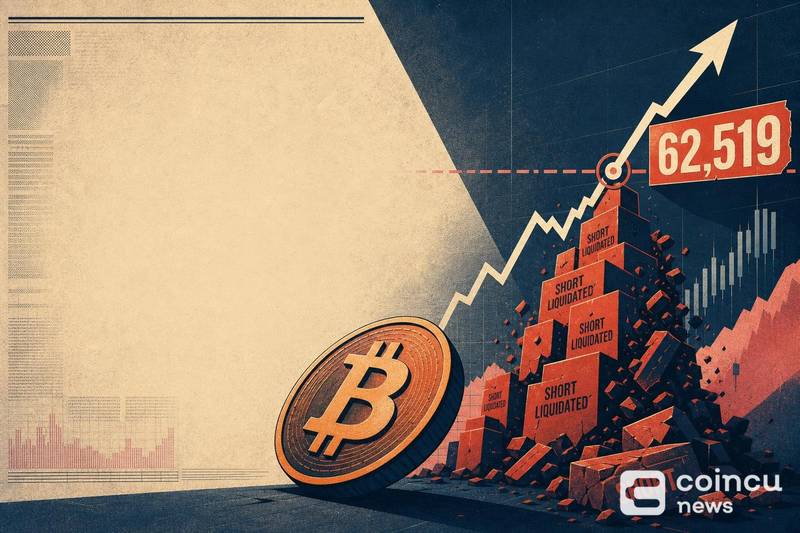
Bitcoin was trading at $59,428 at press time, down about 1.8% over the prior 24 hours. The Fear & Greed Index read 18, firmly in “Extreme Fear” territory, signaling broad risk-off positioning among market participants. For related coverage, see ETH Could Trigger $643M in Long Liquidations Below $1,511, Data Shows.
The gap between the current price and the cited trigger level means that a roughly 5.2% rally would be enough to push Bitcoin into the projected liquidation cluster, potentially setting off a cascade of forced short closures.
Why the $62,519 BTC Price Level Matters
The $62,519 figure comes from a WEEX market brief citing CoinGlass liquidation map data. According to the report, that price level marks a zone where accumulated short positions across mainstream CEXs become vulnerable to forced closure.
Short liquidations occur when traders holding leveraged bearish positions are forced to buy back their contracts as the price moves against them. Exchanges automatically close these positions once margin requirements can no longer be met, converting open short interest into market buy orders.
The setup is conditional, not a confirmed event. It reflects a snapshot of open interest and leverage distribution at the time the data was compiled, meaning the threshold could shift as traders adjust positions.
The Downside Mirror
The same WEEX brief noted a corresponding risk on the long side: if BTC falls below $56,975, cumulative long-liquidation intensity on mainstream CEXs could reach $684 million. A separate Coincu report found that BTC long liquidations could hit $922 million below $61,035, illustrating how quickly these clusters shift as open interest rotates.
With BTC sitting at $59,428, the current price is closer to the long-liquidation floor than to the short-liquidation ceiling, a positioning asymmetry that aligns with the prevailing Extreme Fear sentiment.
How the $897 Million Short Liquidation Estimate Builds Across Major CEXs
CoinGlass aggregates perpetual swap and delivery contract data from leading global exchanges including Binance, OKX, Bybit, and Bitget. The liquidation data updates in real time and tracks the distribution between long and short liquidations.
The $897 million figure represents cumulative short-side vulnerability across these venues, not a single exchange’s exposure. Because centralized exchanges concentrate the majority of leveraged crypto trading volume, liquidation clusters on these platforms can produce outsized price moves compared to fragmented or decentralized venues.
Exchange concentration matters for squeeze dynamics. When forced buying hits multiple order books simultaneously, thin liquidity above resistance levels can amplify the price impact. A previous Coincu analysis noted that BTC above $62,609 could trigger $1.805 billion in CEX short liquidations, suggesting that the short-side exposure at these levels has been a recurring structural feature of the market.
Recent Precedent
On June 8, Bitcoin’s rally to $63,700 triggered $504 million in short-seller losses over 24 hours, with total crypto liquidations reaching roughly $655 million and affecting more than 104,000 traders, according to CoinDesk reporting. That event demonstrated how quickly a move through concentrated short positions can cascade into a broader squeeze.
The current $897 million projection is roughly 78% larger than the short losses recorded during the June 8 event, though the trigger price of $62,519 sits about $1,200 below the $63,700 level that BTC reached during that earlier move.
What a Short Squeeze Above $62,519 Could Mean for BTC Price Action
If Bitcoin reaches the cited threshold, the forced closure of short positions would convert roughly $897 million in bearish bets into market buy orders. That wave of involuntary demand could accelerate price movement beyond what organic buying alone would produce.
Liquidation cascades tend to compress large price moves into short time windows. As shorts get stopped out, their buy orders push the price higher, triggering the next layer of liquidations. The result is a feedback loop where each liquidation generates buying pressure that forces the next round of closures.
However, liquidation maps show pressure zones, not guaranteed outcomes. The actual impact depends on how much open interest remains at those levels when price arrives, how deep the order book liquidity is at each exchange, and whether new short positions are opened to replace liquidated ones.
The current Extreme Fear reading of 18 suggests that sentiment is heavily skewed toward caution. If a rally materializes despite that backdrop, the positioning mismatch could amplify the squeeze, since bearish consensus would mean fewer traders are prepared for upside. Previous BTC rebounds above $60,000 have shown how quickly sentiment can flip when price invalidates the prevailing bearish thesis.
How Traders Should Read Liquidation Data and Its Limits
The headline begins with “Data suggests” for a reason. Liquidation projections are derived from snapshots of open interest and margin levels across exchanges at a specific point in time. As traders open, close, or adjust positions, the map changes.
The $62,519 threshold and $897 million estimate reflect conditions as of June 29. By the time BTC approaches that level, the actual liquidation exposure could be higher or lower depending on how open interest evolves. A sharp move toward the threshold might prompt some short holders to close voluntarily, reducing the eventual forced-liquidation volume.
It is also worth distinguishing between liquidation intensity and realized liquidations. The cited figure represents the cumulative exposure that would be triggered, not a guarantee that the full amount will be liquidated. Partial closures, stop-loss orders placed ahead of the threshold, and exchange-specific risk engine differences all affect the final outcome.
The fact that the CoinGlass liquidation API returned an “API key missing” error during the research phase means the exact $62,519 and $897 million figures could not be independently verified through programmatic access. The numbers are attributed to CoinGlass through a secondary readable report, which is a common sourcing pattern for liquidation data but adds a layer of indirection.
Broader market context, including Bitcoin’s recent moves above $60,000, suggests that the price range between $59,000 and $63,000 remains a contested zone where both long and short liquidation clusters are dense.
FAQ About BTC Short Liquidations Above $62,519
What are BTC short liquidations?
Short liquidations occur when traders who have bet against Bitcoin’s price using leveraged contracts are forced to close their positions because the price has risen beyond their margin threshold. The exchange automatically buys back the contract, converting the short position into a market buy order.
Why does the $62,519 level matter?
According to liquidation map data attributed to CoinGlass, $62,519 is the price at which cumulative short-side exposure across major centralized exchanges reaches a projected $897 million. That concentration of vulnerable positions makes it a potential inflection point where forced buying could accelerate upward price movement.
Is the $897 million figure guaranteed?
No. The figure is a projection based on a snapshot of open interest and leverage at the time the data was compiled. As traders adjust their positions, the actual exposure at that price level will change. Liquidation maps are dynamic tools, not fixed predictions.
Which exchanges are included in this data?
CoinGlass aggregates perpetual swap and delivery contract data from major exchanges including Binance, OKX, Bybit, and Bitget. The $897 million figure reflects cumulative exposure across these platforms.
How far is Bitcoin from the trigger level?
At the latest recorded price of $59,428, Bitcoin sits roughly $3,091 below the $62,519 threshold, a gap of about 5.2%. Recent volatility, including the June 8 rally to $63,700 that liquidated $504 million in shorts, shows that moves of this magnitude can occur within a single trading session.
Disclaimer: This article is for informational purposes only and does not constitute financial or investment advice. Cryptocurrency and digital asset markets carry significant risk. Always do your own research before making decisions.
No tags available.


Other Posts








- China, US Conclude Trade Talks with Focus on Cooperation
- Crypto Weekly: NYSE Backs OKX, Kraken Gets Fed Access, BTC Sells
- DeriW Launches Edge Hour Trading Competition Platform for Derivatives Traders
- Court Upholds Fed’s Rejection of Custodia Bank’s Request
- Former CFO Convicted for $35M Fraudulent Crypto Investment
- Michael Saylor Denies Bitcoin Sell-Off Amid Large BTC Transfer
- Buy Dogecoin on eToro: Step-by-Step Guide for Beginners (2024)
- Kazakhstan Explores Crypto Reserves Backed by National Funds
- JPMorgan Increases Holdings in BlackRock’s Bitcoin ETF
- Nordea Bank Introduces Bitcoin ETP Trading for Nordic Customers
- XRP Spot ETF Launches on Nasdaq Amid Market Fluctuations
- Crypto Leaders Address Macro Volatility Amid Market Shifts
- Peter Schiff Challenges Michael Saylor on MSTR’s Business Model
- Thailand Orders Worldcoin to Delete 1.2 Million Biometric Records
- UK Proposes New DeFi Tax Framework to Ease User Burden
- WLFI Under Fire: Analyst Warns Hyperliquid Could Be Next
- Ancient Ethereum Whale Moves $1.19 Billion After Decade
- BlackRock Receives Large Crypto Transfers from Coinbase
- SEC Scrutiny on ALT5 Sigma’s Leadership Disclosure Timing
- MoonPay Gains Trust License for Crypto Operations in New York
- China, US Conclude Trade Talks with Focus on Cooperation
- Crypto Weekly: NYSE Backs OKX, Kraken Gets Fed Access, BTC Sells
- DeriW Launches Edge Hour Trading Competition Platform for Derivatives Traders
- Court Upholds Fed’s Rejection of Custodia Bank’s Request
- Former CFO Convicted for $35M Fraudulent Crypto Investment
- Michael Saylor Denies Bitcoin Sell-Off Amid Large BTC Transfer
- Buy Dogecoin on eToro: Step-by-Step Guide for Beginners (2024)
- Kazakhstan Explores Crypto Reserves Backed by National Funds
- JPMorgan Increases Holdings in BlackRock’s Bitcoin ETF
- Nordea Bank Introduces Bitcoin ETP Trading for Nordic Customers
- XRP Spot ETF Launches on Nasdaq Amid Market Fluctuations
- Crypto Leaders Address Macro Volatility Amid Market Shifts
- Peter Schiff Challenges Michael Saylor on MSTR’s Business Model
- Thailand Orders Worldcoin to Delete 1.2 Million Biometric Records
- UK Proposes New DeFi Tax Framework to Ease User Burden
- WLFI Under Fire: Analyst Warns Hyperliquid Could Be Next
- Ancient Ethereum Whale Moves $1.19 Billion After Decade
- BlackRock Receives Large Crypto Transfers from Coinbase
- SEC Scrutiny on ALT5 Sigma’s Leadership Disclosure Timing
- MoonPay Gains Trust License for Crypto Operations in New York
- China, US Conclude Trade Talks with Focus on Cooperation
- Crypto Weekly: NYSE Backs OKX, Kraken Gets Fed Access, BTC Sells
- DeriW Launches Edge Hour Trading Competition Platform for Derivatives Traders
- Court Upholds Fed’s Rejection of Custodia Bank’s Request
- Former CFO Convicted for $35M Fraudulent Crypto Investment
- Michael Saylor Denies Bitcoin Sell-Off Amid Large BTC Transfer
- Buy Dogecoin on eToro: Step-by-Step Guide for Beginners (2024)
- Kazakhstan Explores Crypto Reserves Backed by National Funds
- JPMorgan Increases Holdings in BlackRock’s Bitcoin ETF
- Nordea Bank Introduces Bitcoin ETP Trading for Nordic Customers
- XRP Spot ETF Launches on Nasdaq Amid Market Fluctuations
- Crypto Leaders Address Macro Volatility Amid Market Shifts
- Peter Schiff Challenges Michael Saylor on MSTR’s Business Model
- Thailand Orders Worldcoin to Delete 1.2 Million Biometric Records
- UK Proposes New DeFi Tax Framework to Ease User Burden
- WLFI Under Fire: Analyst Warns Hyperliquid Could Be Next
- Ancient Ethereum Whale Moves $1.19 Billion After Decade
- BlackRock Receives Large Crypto Transfers from Coinbase
- SEC Scrutiny on ALT5 Sigma’s Leadership Disclosure Timing
- MoonPay Gains Trust License for Crypto Operations in New York


BTC 8-Hour Average Funding Rate at 0.0028% Signals Balanced Market Bias

Toss Brings 30 Million Users Into the AI Data Economy in Partnership With Poseidon

The DATA Foundation Launches to Tackle AI’s Multi-Billion Dollar Training Data Bottleneck